Across Georgia, a new generation of robots are entering workplaces once defined entirely by human labor. Rather than replacing employees, these machines are designed to handle dangerous, dirty and difficult tasks that strain workers. In doing so, they’re helping people move into safer, more sustainable roles.
At Hyundai Motor Group Metaplant America in Savannah, that future is approaching quickly as the company prepares to introduce humanoid Atlas robots in 2028.
“Atlas will be supporting our employees, which we call Meta Pros, by performing the more repetitive and hazardous tasks,” Brent Stubbs, Chief Administrative Officer at HMGMA, said.
Stubbs said the goal is to reduce long-term strain on workers as the plant grows.
“This will allow our Meta Pros to work in a safer environment with fewer injuries and hopefully retire happier and healthier than others doing similar jobs in the industry,” Stubbs said.
While Hyundai prepares for humanoid robots, Atlanta-based startup Undaunted is already deploying robotic security dogs.
“Traditionally, you’d have a security guard doing what’s called a guard tour around a property where they’ll scan QR codes or touch RFID things across the property to make sure that they’re moving and checking different places,” Bryan Dinner, CEO and Founder of Undaunted, said.
Dinner said the company’s approach depends on keeping humans in control of robots.
“You need a person to be on the other side for people to listen, and for you to make the right decisions as you’re making security,” Dinner said.
Robotics is also reshaping work in environmental and pest-control industries, where Ground Control Robotics is testing SCUTTLE robots for tight, hazardous spaces.
“If [someone] has to go into a crawl space or an attic, [having] a robot that could do that to assist a technician could be a very valuable thing,” Dr. Dan Goldman, Co-Founder and CEO of Ground Control Robotics, said.
Dr. Goldman said the company’s robots are fully human-controlled as they begin field testing.
“With the current SCUTTLE robot, you can imagine a technician has eyes and potentially ears and potentially even hands in hard-to-reach, complicated environments,” Dr. Goldman said. “The technician could be driving the robot remotely and be able to go to places that would be dangerous or hazardous or that they can’t really get into.”

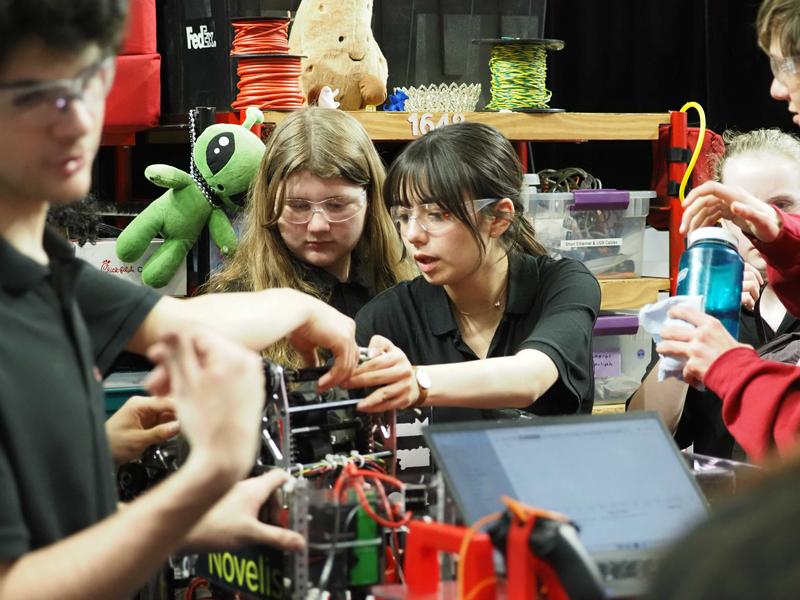
Angela Marshall, teacher adviser for Midtown’s G3 Robotics team, said robotics students quickly learn how much the design process depends on human judgment.
“They draw on collective experience, prior robot performance, budget constraints, competition field conditions and available support to assess the team’s strengths, weaknesses and areas that can realistically be improved to competitive levels,” Marshall said. “These human judgment and diagnostic skills act as feasibility filters, guiding how technology is used and ensuring that design choices are both innovative and achievable.”
Marshall believes robotics education must prepare students for a world where technology complements human decision-making.
“Students should be developing strong foundations in mathematics, computer science, communication and, most importantly, problem-solving, so they can thoughtfully determine when technology should serve as a tool rather than a replacement for human judgment,” Marshall said. “Many industries are actively examining this balance and have found that tasks requiring discernment, intuition and contextual understanding cannot yet be fully automated.”
At HMGMA, robots already support workers through guided vehicles and Spot robot dogs.
“Everyone who works at HMGMA is trained to work around robotics safety, respecting each other’s roles and learning to work together in harmony,” Stubbs said. “We already have robots, Autonomous Guided Vehicles (AGVs), Spot robot dogs and other technology that work alongside us every day.
Stubbs said concerns about job loss reflect earlier technological shifts that ultimately created new roles.
“When ATMs were first announced, there was a belief that teller roles would be eliminated,” Stubbs said. “That wasn’t the case. The teller role still exists and is still valuable, but it evolved into a more customer-focused role.”
Dinner recognizes a similar pattern emerging in security as new roles appear around robot operations.
“People [in our control center are] operating robots, monitoring cameras, communicating with the property and communicating with the police,” Dinner said.
Dr. Goldman said robotics is creating new categories of work that require interpretation, judgement and technical skill.
“I think that folks who are able to pilot those well and interpret the complex signals that are coming, it’s like you get a new sensor and get a new device and you have to learn how to use it,” Dr. Goldman said. “There’ll be people who are really good, you have people who’ll be pretty good. And I think that there can be jobs for people who will be training people how to use these.”
At the Metaplant, the shift has prompted new training programs for young workers entering the field.
“In addition, we have an Apprenticeship program that is helping new high school graduates with the skills they need to support the technology at The Metaplant–robots included,” Stubbs said.
Undaunted has also expanded its workforce as demand for robotic security grows.
“We got like 25 people that are in our mission control center,” Dinner said. “I would expect our full-time staff to double or triple in the next six months and the contractor group to also double or triple in the next six months, if not more.”
Dr. Goldman said the long-term future of robotics will involve more autonomy, but always with humans in the loop.
“Now, the autonomy will be a very valuable piece,” Dr. Goldman said. “We think in certain industries it may be better for swarms of these robots to wander around and do jobs that would otherwise be hard for one person to control a lot of robots, [like] robots running around a crop field looking for weeds [or] pests, things that are harmful to the crops, without someone having to necessarily focus on driving them around.”
Marshall emphasizes that even as robotics advances, the human element remains central to how technology succeeds.
“School robotics programs help students understand the real-world relationship between people and technology by emphasizing the integration of human and technical skills,” Marshall said. “This process teaches students that successful technology is not just about what a machine can do, but how well it is designed to work in conjunction with the people who use it.”