Retired pastor Olu Brown began his campaign for Georgia governor after growing the East Point Impact Church from 25 people to a mullti-million dollar megachurch. With a long career in faith leading and education with his Lifetime Teacher’s Certificate, Brown adds into the democratic ring of governor candidates, taking a faith-rooted approach.
“I remember being in elementary school, reading the Constitution, adding up the years that I needed to be to run for office,” Brown said. “I am living my trade as a public servant, and that’s been my whole career. Twenty five years ago, I packed behind the civic factor, beating Texas, and part of an all Interstate-20, and 12 hours later, I got off in the Atlanta University Center to continue my education. So, now 25 years later, I’m running for governor. I’m running because I want a Georgia where every kid has the possibility that I’ve had over my past 25 years here in this state.”
Brown was motivated to run for the election by the current political conditions in Georgia and the U.S., and the problems he wants to solve such as education, and healthcare.
“I’m running for governor because we can do something about education; we can do something about healthcare; we can do something about equality for women, and most importantly, we can make Georgia bigger and healthier for everyone,” Brown said. “If you have a leader who sees, you have a leader who cares, and if you have a leader who has courage, we can make a difference for all Georgia.”
Brown cited his experience as a pastor, and establishing Impact Church, and noted how this experience can show voters how he helps fight for people’s needs, and that he plans to continue this sentiment.
“As a former faith leader, we started a church called Impact Church in East Point, Georgia,” Brown said. “We only had 25 people, and we bought this warehouse, 76,000 square feet, 10 acres of land. It was blinded to the community. A lot of people thought we were just building a church, but it was much more than the church. It is one of the largest congregations in the state of Georgia. It became one of the fastest-growing in the United States of America, but do you know what else it is? It’s a voting precinct. It’s a place that helped me with these folks that are running against me to get elected. That’s what I’ve done my whole life. I made a way for other people. I made a difference. I’ve led it with courage, and it’s never been about me. It’s always been about the people, and that’s what I will do as your next coming.”
Keisha Carter, Brown’s Campaign Lead added onto this theme of Brown helping people directly, explaining he cares about Georgia and its citizens.
“Olu is not a career politician; he is an executive and a builder who started one of the fastest-growing community organizations in the country from the ground up,” Carter said. “His vision for Georgia’s “Next Chapter” is structural. He doesn’t just want to manage the state’s current problems; he wants to build new systems—from how we fund our schools to how we protect our local supply chains—that ensure Georgia is the number one state for a family’s quality of life, not just a playground for corporate interests.”
Demetrius Tatum, a Christain and democratic voter explained how a faith leading, democratic governor could represent his beliefs as a Christian and a democrat simultaneously.
“A Christian-democratic governor could represent what I believe are true Christian values by focusing on compassion, justice and healing the country,” Tatum said.
With many Christian beliefs being associated with MAGA, Tatum believes a Christian democrat can meld views of each title.
“I think the key difference would come down less to party labels and more to governing style and how they can work across the party lines,” Tatum said. “A Christian Democrat might try to bridge gaps between parties and focus more on shared moral values.”
One main focus of Brown’s campaign is housing costs. Carter explained Brown’s initiatives and what they are planning to achieve if elected.
“We are prioritizing a $2 billion opportunity fund to tackle housing costs, the “$50k Starting Line” to end the teacher shortage, and the “12+2 Promise” to guarantee high schoolers access to trade certifications,” Carter said. “We prioritized these because Georgians are tired of minimum-wage debates; they want a high-wage skills economy.”
Brown’s education agenda highlights the importance of not blaming kids themselves for unpreventable situations and outcomes.
“As I drop my 14-year-old off at school, and I get that opportunity most days a week, and it’s a great joy, and I look at him, and I realize, I’m gonna pick him up later in the day; he is with his educators and school community more than he is with his parents in concentrated hours,” Brown said. “So, our schools are our front line of defense to make sure we do everything we can, as your next governor. I see it as a moral mandate. First, we got to stop criminalizing behavior with kids, and they’re just crying out for help. We gotta stop criminalizing poverty. We gotta stop criminalizing mental health. They have to stop criminalizing deliberacy. ?We have to stop criminalizing family backgrounds.”
Brown notes his plan to combat this as installing a program that allows graduated students to continue their education and start working successfully after high school.
“We’ll present the 12 plus two promise,” Brown said. “For every kid graduating from a high school in the state of Georgia, they will receive a two-year certificate, so that when they graduate, they have a lot of choices to be successful young adults because a young man or a woman who has a certificate, or a welding torch in their hands, they don’t have time to get into trouble. You just gotta have a governor who gives a damn, and who is willing to make a difference. I’m Olu Brown, and I want to be that governor, who gives a damn.”
As for healthcare, Brown cited the rate of infant and maternal mortality. His time as a pastor has given him many interactions with families struggling from these outcomes, he noted.
“Forty eight out of 100,000 African-American women died in childbirth, and 87% of maternal deaths are considered formidable,” Brown said. “And this is really about maternal health, and it’s also about infant health. I can honestly say, as a faith leader, there’s not a single hospital I haven’t visited in Fulton County or DeKalb County. Many of those hospital visits were for women who were having typical pregnancies. As a former pastor, I’ve done a lot of funerals, but those I will never forget, are those of infants, are being called to my hospital, two and three, a.m., to say our baby didn’t make it.”
To address this, Brown plans to introduce a rural Health Enterprise Zone plan to support those with a lack of or little access to healthcare in rural Georgia.
“We have to do something in Georgia, and we can do it,” Brown said. “I will introduce the rural Health Enterprise Zone Plan that will create tax-free zones for OBGYNs, and how to tell the zip codes throughout our state. So, no woman has to suffer, no family has to suffer, and our children are born healthy and vital, and we can have healthier and well prosperous children.”
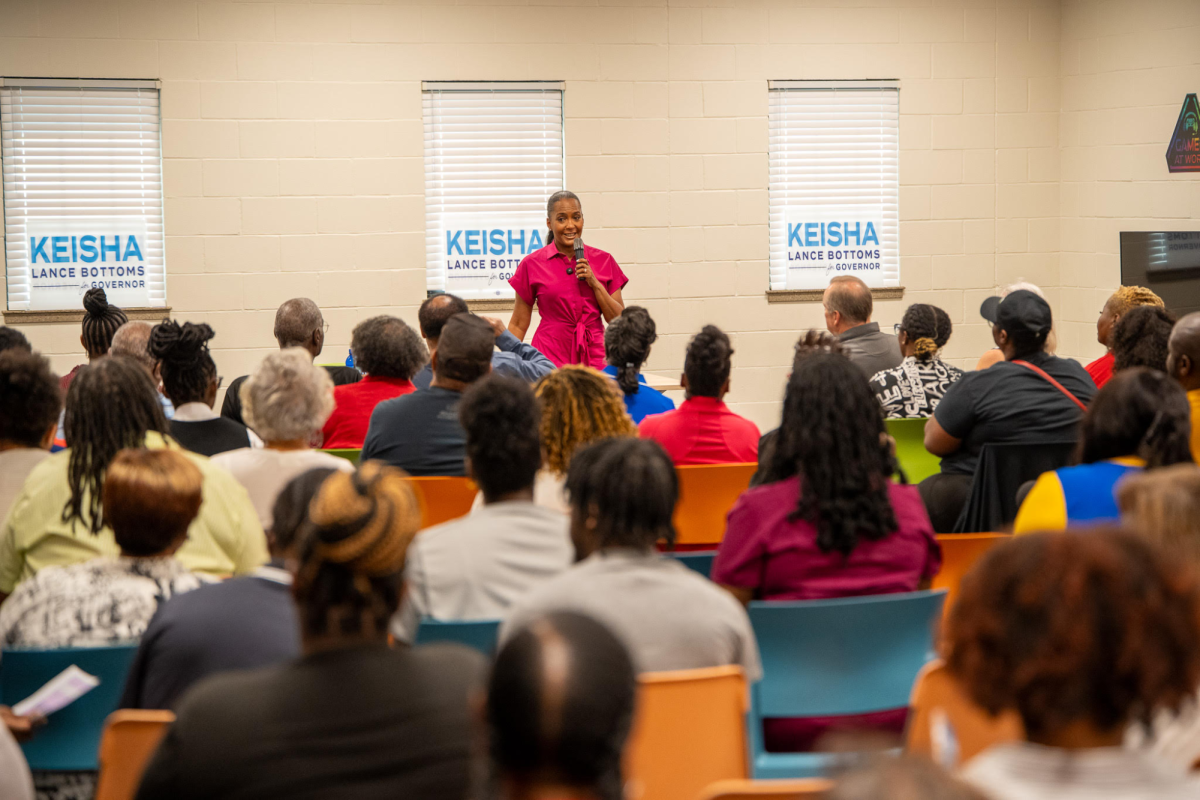
With a large democratic candidate pool, elections will be tight, according to Carter. Additionally, the majority of rural areas in Georgia being republican makes for an even harder election, she said. She explained how the campaign measures success throughout by knocking on doors and meeting face to face with voters, in addition to polling numbers.
“We measure success by the depth of our community engagement, especially in areas that Democrats traditionally ignore,” Carter said. “When we hold a “Breaking Bread & Building Bridges” lunch in a place like Blackshear, Georgia, and the room is packed with local trades workers, parents and seniors looking at our policy blueprints, that is a massive success. We also track volunteer metric shifts — how many people are moving from passive supporters to active “builders” who are writing postcards and knocking on doors.”
Carter noted the most common concern she has seen from voters throughout the campaign is worrying about the future of Georgia and politics as a whole, and explained how this has affected their campaign approach.
“The overwhelming feedback we hear on the ground is anxiety,” Carter said. “Voters are deeply stressed about the cost of groceries, the housing market and the very real threat of federal overreach into their healthcare and voting rights. They feel like politicians are taking a wrecking ball to their stability. That feedback directly influenced how we communicate: voters don’t just want an optimistic visionary right now; they want a protector.”
Carter highlights the strategy of the campaign, the shifts it has had throughout its course and the end goals after the election to build a better Georgia for all.
“When we launched, our message was heavily-focused on the optimistic idea of being the ‘Architect of Georgia’s Next Chapter,’ but as we spent more time on the ground listening to voters’ anxieties about the national political climate, our strategy evolved to meet the moment,” Carter said. “We shifted from a purely optimistic builder to a protective builder. Our message now is clear: while others swing a wrecking ball at your rights, Olu is going to build a firewall around Georgia to protect your wallet, your health and your democracy. We are done talking. It’s time to build.”