Mayor launches new development plan
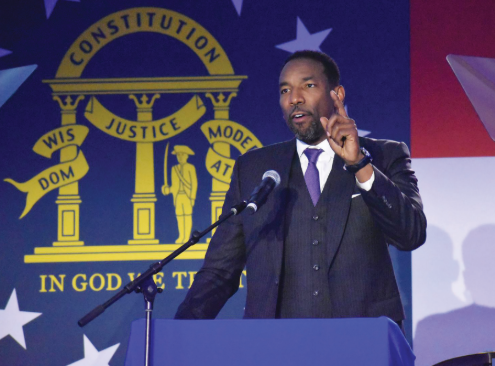
Mayor Andre Dickens has recently proposed a new $5 billion development plan aimed at revitalizing underserved communities across Atlanta, specifically targeting the city’s south and west sides.
The draft of the plan includes the funding of large transit projects with MARTA and the BeltLine, significant expansions in affordable housing, improved access to fresh food and increased health initiatives. Atlanta City Council member Matt Westmoreland believes the plan would be extremely beneficial to the communities in these areas.
“The mayor has proposed a really transformative set of ideas to make really significant investments in a number of historically underserved communities,” Westmoreland said. “I fully support that goal. I think virtually all, if not all, of my council colleagues support that too; it’s a huge proposal.”
Recently, the Atlanta City Council approved an oversight commission for the plan that will review the plan and deliver suggestions before a council vote. Andre Dickens’ chief of staff, Courtney English is excited to work with the commission to pass the plan.
“The council created a neighborhood reinvestment commission, which is designed to look at project delivery, governance, oversight and accountability,” English said. “They begin work in January, and so we look forward to participating in that commission and working with them to answer some of the outstanding questions that the council and public may have.”
After the council votes, the mayor’s office aims to then begin work on funding these projects.
“We’ve identified housing projects throughout the city that are ready to go; they’re just awaiting funding,” English said. “Ideally, we get Council’s support; we get the school board support, and then, ultimately, we get Fulton county’s support. The next step in the process is we will go out and borrow money against the future tax revenues that will inject cash and allow us to start spending money almost immediately. Once we get council approval and go through the bond process, we could be spending money as early as next June.”
English believes the plan is essential to solve some of the city’s biggest problems, ranging from housing affordability to healthcare rates.
“The biggest things that hold the city back are that in some neighborhoods, there’s no affordable housing, no access to healthcare, no access to reliable transit, higher rates of diabetes and higher rates of being uninsured,” English said. “Once we realized what the data told us, we asked ourselves ‘well, how do we change it?’ Where we landed was that you have to make investments to build, create and attract the kind of amenities that will create healthy, whole communities.”
English believes the biggest benefit of the plan is its impact on affordable housing throughout the city, as it would improve opportunities to lower-income communities.
“The bedrock of any healthy community is the presence of affordable housing and mixed income housing, as well — 1.8 million [more] people are going to live in the metropolitan area by 2050, another 200,000 are going to move to Atlanta over the next 10 years,” English said. “All of those people can’t live in Midtown and Buckhead, so as great as those neighborhoods are, we have to ensure that neighborhoods throughout the city have enough affordable housing to meet that demand.”
In order to fund the plan, Dickens proposed extending the eight tax allocation districts (TADs) in Atlanta, which means that an increase in property taxes would be reserved for funds for the plan. Westmoreland believes the proposed method would be effective in raising funds for the plan.
“TADs are a tool that started in Georgia in the early ‘90s,” Westmoreland said. “The idea is that we freeze the tax revenue that the city, county and school system gets for 25 years at whatever level property taxes were. As development happens in that area and property tax revenues increase, anything above the frozen level goes to InvestAtlanta to be invested back into the TAD to continue community redevelopment programs.”
In order to best understand the needs of the communities, Dickens’ office has been working with different areas for years.
“We’ve been meeting with folk on a monthly basis in seven main communities throughout the city for two years to unpack what a potential plan could be to invest in those areas,” English said.
The goal of the plan is that as property taxes increase in more developed areas, that revenue is redistributed to less developed areas of Atlanta.
Lisa Boyd, AP Seminar, Language and Research teacher, believes that by redistributing wealth, Atlanta can become more integrated.
“I think it’s interesting because a lot of the English classes recently had some big discussions about gentrification,” Boyd said. “I think that the vast majority of the plan is for affordable housing and increasing accessibility, which is really needed if we want to be an integrated city that focuses on underserved communities.”
The plan’s goal in mind is to ultimately end inequality across the city. English believes it is a large issue that has affected thousands.
“Inequality doesn’t work; it is a bad economic model, and Atlanta happens to be the most inequitable city in the country,” English said. “We are dead last in terms of economic mobility. A child born into poverty in the city of Atlanta has a 4.5% chance of making it to the upper middle class before they die. We have one of the highest rates of child poverty. We have one of the widest wage gaps in the entire country. And it doesn’t have to be that way.”
English believes by instating the plan, there can be a reversal in this problem across the city.
“The plan represents the largest investment in affordable housing in Atlanta’s history, the largest investment in transit in Atlanta’s history and the largest investment in increasing access to healthcare and fresh food in Atlanta’s history,” English said. “This has exponential benefits to not just people living in those communities, but across the city. When we tackle poverty head on, we see higher rates of school proficiency, lower rates of crime and our economy gets stronger.”
Boyd believes the plan represents a broader-scale battle against political leaders ignoring inequalities throughout the nation.
“In the context of our national political conversation, political leaders are trying to ignore racial differences, economic disparities and systematic issues that have divided Americans,” Boyd said. “I think it’s really pivotal that Dickens is standing up to make this statement now and to try to put this into action because these next two and a half years are really critical in where we go as a county.”
However, a large critique of the proposed plan is that after the current TADs expire, the funds are supposed to go towards supporting Atlanta Public School. On top of this, while the mayor’s office predicts that the extensions of the TADs would bring in $5.5 billion, the actual cost of the listed projects in the plan amount to around $14.7 billion. Atlanta City Council Member Kelsea Bond believes this plan may take too much away from funds that could be spent on improving public school education in the city.
“I am personally skeptical of extending the TADs for the reason that it does take funding from our public schools,” Bond said. “The TAD extension plans to raise over $5 billion and about half of that revenue would have otherwise gone back to APS. It’s really the public schools that would be missing out here disproportionately.”
Bond believes that instead of funding the plan through TADs, the city should increase taxes in wealthier areas.
“My counterargument is that we have luxury commercial properties and high rises all around Midtown and the rest of the city that are underappraised by Fulton County,” Bond said. “Studies have shown that we are missing out on hundreds of millions of dollars in tax revenue because we’re not taxing very wealthy property owners. I would rather see us taxing the ultra wealthy as opposed to taking funding from public schools.”
However, English explained that the mayor’s office chose TADs as a source of funds because of their scale and the fact that they don’t raise taxes.
“TADs represent the biggest opportunity of funding that doesn’t raise taxes on anybody at all,” English said. “Building 20,000 units of affordable housing over an eight-year period costs $7 billion. TADs represent the largest public financing tool that can bear the cost.”
English believes the development plan represents a continuation of Atlanta’s legacy as a city.
“Somewhere written on paper said Atlanta was a city too busy to hate,” English said. “That moniker isn’t just handed down from one generation to the next. It must be earned. This is the problem of our time.”

Fairlie Mercer is a senior and this is her third year writing for The Southerner. She currently serves as an Editor-in-Chief and is excited for her second year as an editor. Outside of journalism, she enjoys hanging out with friends and dance.