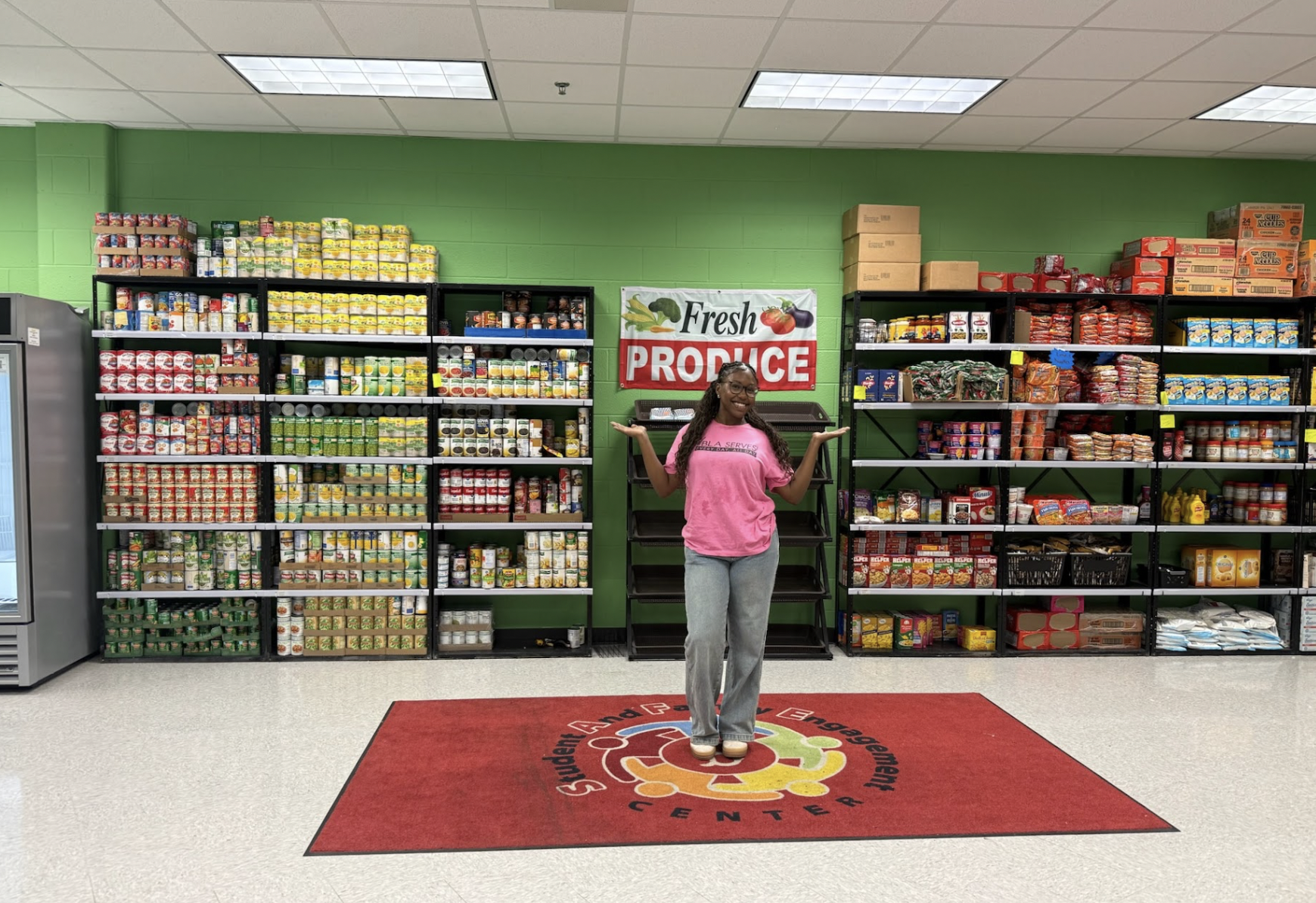
Senior Star Winborn poses under Fresh Produce sign at Banneker High School food pantry. Winborn organizes food distribution for the S.A.F.E. Center as an ambassador and a member of Young Black Leaders of America ( YBLA).
Every week at Banneker High School in College Park, students stop by the Student and Family Engagement Center, a full-scale support center established in 2018. The center offers food, clothing and mental health services, aiming to address disparities students face outside the classroom.
Tifanie Bishop, director of the S.A.F.E. Center at Banneker, said that recently the center has faced difficulty stocking shelves due to a lack of funding.
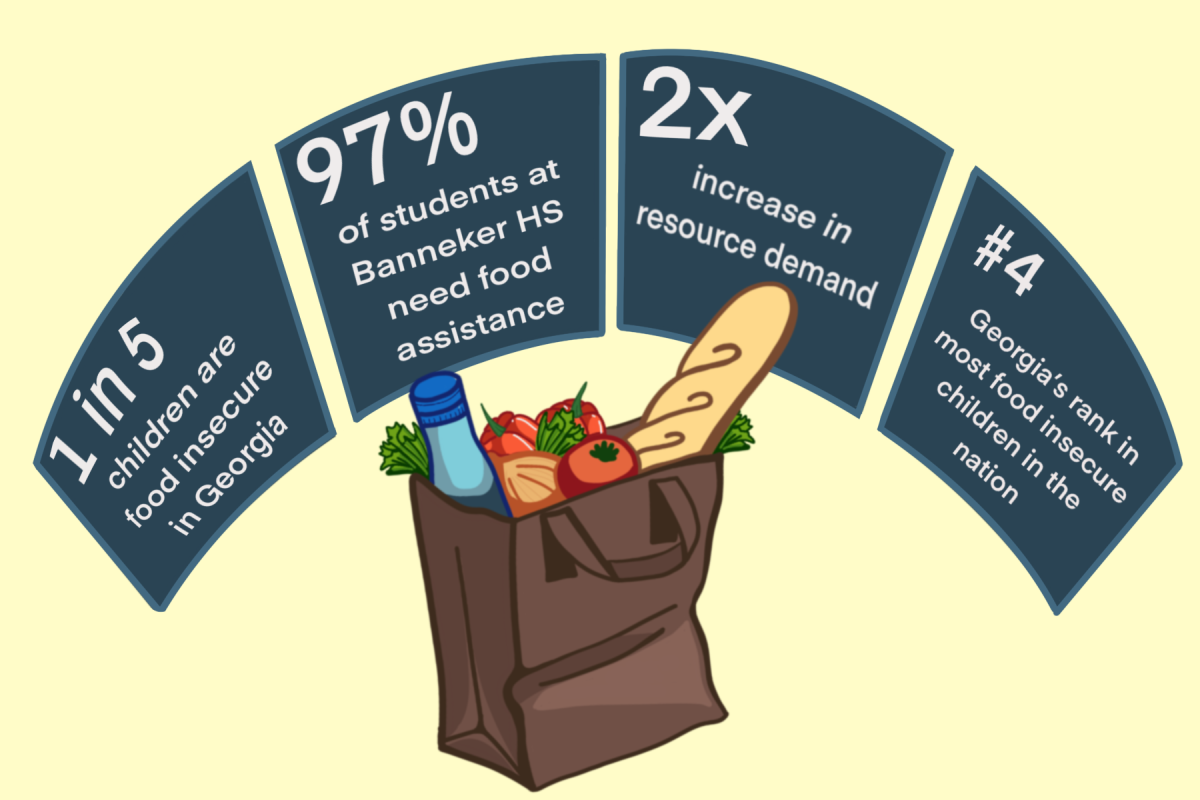
“One of the major challenges we’re currently facing is funding for our food pantry,” Bishop said. “As a Title I school with a 97% poverty rate, this year marks the first time we are relying solely on donations to stock our pantry.”
As the number of students seeking support has grown, the center’s resources haven’t kept pace. The growing need for the S.A.F.E. Center is a defining factor in the limited resources available for students.
“Over the past couple of years, the demand for services provided by the S.A.F.E. Center has doubled,” Bishop said. These services include access to food, clothing, hygiene products, mental health support, group sessions, a sense of community, grief counseling, attendance initiatives, academic enrichment, post-secondary guidance, transportation assistance and home-life support.”
Bishop said the growing strain on the S.A.F.E. Center reflects more challenges students are facing beyond the school walls and how the instability of the center leads to limited focus on education.
“What I’ve observed as part of the driving force behind this change includes shifts in family structure, a decline in the emphasis on education at home and an increase in discipline issues,” Bishop said. “Job and family stability are not as highly prioritized as they once were, creating a trickle-down effect that impacts students within the school system.”
Midtown senior Star Winborn, part of the Young Black Leadership Alliance, said that without government support, the S.A.F.E. Center has become dependent on nonprofit organizations.
“Ms. Bishop shared with me how she has been reaching out to government officials for support and has received no response, making the center reliant on nonprofit organizations for resources,” Winborn said. “Students are now limited to what they can take and that directly affects them and their families.”
NOTEWORTHY NEED: Georgia is ranked fourth in most food insecurtiy children, a situation that impacts their health, education and potential.
Student members of Young Black Leaders of America (YBLA) are given roles at the S.A.F.E. Center. Winborn described her involvement as an ambassador.
“As an ambassador, I was first introduced during my first year with the organization on MLK Day when we visited Banneker High School to create meal bags,” Winborn said. “My role was orchestrating a plan for food distribution and organization. As the service day leader, I guided my fellow ambassadors in organizing food donations, counting and storing them in the S.A.F.E. Center.”
The process for requesting assistance can be achieved in a multitude of ways, Bishop explained.
“Students can request support in several ways: by coming directly to a member of the S.A.F.E. Center team, visiting our store in the morning before homeroom or scanning the QR code located in the Peace Room or on the store door to let us know they are in need,” Bishop said. “At the beginning of the year, we make it a priority to attend grade-level meetings to educate students about the S.A.F.E. Center and the services available. We also share announcements throughout the year to ensure students remain aware of these resources. I also speak at staff meetings to keep teachers informed.”
Winborn said her team’s efforts extended beyond just sorting donations.
“We prepared the food and supplies by first collecting donations from families, organizations and friends,” Winborn said. “On the day of service, we grouped and organized the donations by items, such as hygiene and food products. We cleaned the S.A.F.E. Center by throwing away old products and moving products to different areas to maximize the space. Afterwards, we counted the items and aided Ms. Bishop in cleaning and organizing the S.A.F.E. Center for stocking.”
Fellow YBLA member Lauren Winfrey serves as a leader in organizing efforts towards the S.A.F.E. Center.
“My role was serving as the lead organizer over the hygienic section of the S.A.F.E. Center,” Winfrey said. “Although families and students weren’t present on the day we volunteered, we heard directly from the principal about how our work impacted the community and how much the families appreciate the support.”
Family, community impact of funding cuts
Bishop highlighted the impact of decreasing food donations and assistance on the surrounding community.
“When our weekly food distribution for the community was reduced to twice a month at this location, it had a significant impact,” Bishop said. “We previously served 100–150 cars each week, so this change was difficult. However, the decision was not made lightly — it was due to a decrease in the amount of food we were receiving from the Atlanta Community Food Bank. It’s important to understand that many of our community members who attend the food drive are older citizens. They often line up as early as 1 p.m. for a distribution that begins around 4 p.m.It was heartbreaking to see them wait for hours only to receive one or two items, when they were accustomed to receiving full bags of food.”
Winborn said the most eye-opening part of her experience was being exposed to the many students who are in need of services provided by the S.A.F.E. Center.
“[Bishop] explained to me just how many students are affected by the funding cuts and the difficulty of telling them to only pick up a few items per visit to allow for others to also receive support,” Winborn said. “That experience showed me just how pivotal the S.A.F.E. Center is in supporting their students beyond education, and how much it means to those who helped create and use it. The students and their families sometimes rely on the S.A.F.E. Center for basic necessities, making it extremely important for the school to have.”
Amidst her experience, Winfrey said that a moment of realization dawned upon her while witnessing the impact of the S.A.F.E. Center.
“The most eye-opening part for me was realizing how much the S.A.F.E. Center operates like a grocery store, except everything is free,” Winfrey said. “Many families depend on it because they don’t have the financial resources to buy basic necessities. I didn’t realize that some students don’t have consistent meals at home, and seeing how the school steps in to help completely changed my perspective.”
Winfrey explained key factors that have affected funding to programs beyond the S.A.F.E. center.
“I learned that the S.A.F.E. Center struggles with low funding,” Winfrey said. “Due to recent changes in our current administration, federal support for DEI-related programs has been reduced, which directly impacts resources for students who rely on these services. Overall, the experience opened my eyes to the real needs in the community and how important it is to support programs like the S.A.F.E. Center.”
In addition to funding shortages, food distribution at the center has been stalled due to scheduling changes. Bishop said the shift is already affecting how often the center can serve families.
“Funding to the Atlanta Community Food Bank has been reduced, which directly affects our weekly food distribution,” Bishop said. “Historically, we’ve been able to provide food once a week, but beginning in October, we will shift to distributing food only on the second and fourth Thursdays of each month. This change will significantly impact both our pantry and the families we serve, especially since we had hoped to supplement our pantry with items from the food drive.”
Bishop described a moment of realization on the effect of student needs and the readily available resources.
“During a recent fire drill, it was very cold outside, and I noticed many students without coats,” Bishop said. “Initially, I assumed they had left their coats inside in the rush to exit, but after asking a few students, I learned they didn’t own one. As soon as we returned inside, I immediately created a flyer for a coat drive — and coats started pouring in.”
As the center works to stretch limited resources, Bishop said even small contributions can make a meaningful difference for students and their families.
“The contributions that make the biggest difference to our school include, food for our pantry — especially microwaveable, easy-prep meals — as well as hygiene items, such as soap, toothpaste, deodorant, toothbrushes and body wipes,” Bishop said. “Clothing donations like hoodies and coats are also greatly appreciated.”
Emily Eckmann is a junior and is extremely excited for her second year on the Southerner. Aside from working on the paper, Emily competes with the Midtown debate team and plays on the varsity tennis team. In her free time, she enjoys traveling and hanging out with her friends.
Mariam Darb, Lifestyle & Social Media Managing Editor
Mariam Darb is a senior and this is her final year on the Southerner! When she’s not writing and managing the Southerner’s social media, she spends her time around advocacy and civic engagement. Outside of school, she loves designing clothes to sew, reading, and painting.
Comments (1)
The Southerner intends for this area to be used to foster healthy, thought-provoking discussion. Comments are expected to adhere to our standards and to be respectful and constructive. Furthermore, we do not permit any of the following inappropriate content including: Libel or defamatory statements, any copyrighted, trademarked or intellectual property of others, the use of profanity and foul language or personal attacks.
All comments are reviewed and approved by staff to ensure that they meet these standards. The Southerner does not allow anonymous comments, and requires a name and valid email address submitted that are variable. This email address will not be displayed but will be used to confirm your comments. Online comments that are found in violation of these policies will be removed as quickly as possible.















Jamie Winborn • Dec 15, 2025 at 9:25 am
That’s my baby!! I’ve always stressed the importance of helping because your Father was once a kid that many people helped ????