
Many Black students aim to attend an HBCU, but as college costs continue to rise, many students are struggling to pay their tuition and school fees. Many students have turned to crowdfunding and platforms such as GoFundMe to cover tuition.
Students describe struggles, such as insufficient scholarships, student loan ceilings and unexpected financial burdens. Morehouse College senior Marion Benson shares his personal experience while attending Morehouse as a first-generation student.
“The reality hit the hardest between my junior and senior year when I faced a significant funding gap,” Benson said. “Despite my efforts to secure aid, I reached a point where I could no longer remain on campus. I ultimately had to take a semester off, return home to Greenville to regroup and figure out how to bridge the financial divide before I could return for my senior year.”
Benson created a GoFundMe his junior year of college as a “backup” plan after he was forced to leave campus due to lack of funding. Benson also works an on-campus job to help cover costs on top of balancing volunteering, writing for the Maroon Tiger newspaper and leading multiple student organizations. Benson said the anxiety had become paralyzing.
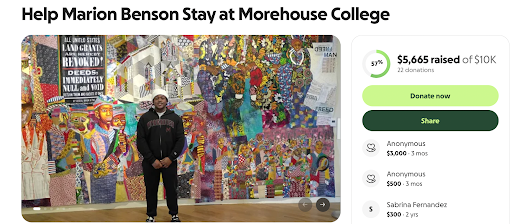
“I want people to understand that a GoFundMe is a last resort — it is a cry for help,” Benson said. “No student wants to be in a position where they have to crowdsource their education, but the reality is that many of us weren’t prepared for the lack of affordable options.”
Howard University in Washington, D.C. is one of the most expensive HBCUs, costing $30,000 dollars per semester. Howard University junior Sincere Jackson is currently on an academic pause due to his outstanding tuition balance. He currently resides in Philadelphia to pay his balance back.
“There were definitely some tears shed,” Jackson said. “There were definitely some times where I didn’t know what I was going to do or what was going on, but it is what it is, and [at] the end of the day, the only thing you can do is just keep going, no matter what, even if it might be the biggest loss that you might have.”
Jackson explains that last summer a lot of Howard students were getting billed, having outstanding balances that they thought they had paid or appearing without warning. Jackson said he was surprised when he saw his $7,000 dollar balance.
“I believe somebody gave Howard a lot of money, and all of that money can take care of a lot of people who are dealing with these situations right now because, at the end of the day, the whole point of just having college or having university is to get more students to graduate and have that on their resume,” Jackson said. “Howard is the No. 1 HBCU of all time. But our money is going towards unnecessary things”
Jackson believes Howard should listen more to its students. Spelman College freshman Terana’jah Geddis said many of her peers have turned to GoFundMe to help pay for tuition.
“Around the end of last semester, that’s when all the GoFundMe’s started to pop-up,” Geddis said. “It was just GoFundMe after GoFundMe, which is really sad, especially because we go to a really prestigious school; so, all these kids are coming here, and they can’t afford it.”
A first generation and freshman herself, Geddis says she feels the importance of attending an HBCU. Geddis explained that she knew it would be a risk coming to Spelman as she came from a low-income family, but described how motivating it was when the hard work she was putting in ended up paying off.
“Secondary education is a privilege … having post-secondary education in itself is really challenging,” Geddis said. “But especially going to somewhere like Spelman, they aren’t really giving [scholarships] out like that, you really have to beg for it.”
Geddis points out that HBCUs such as Spelman do not receive as much funding as Predominantly White Institution (PWIs). She also highlights that because Spelman is a private institution there is not as much financial aid. Despite financial frustrations, Geddis did not let that stop her, as she eventually received a scholarship and raised the money she needed on GoFundMe, successfully paying her tuition.
“As soon as I started the GoFundMe, I had $1,000 on the first day, so [I thought] this might be possible,” Geddis said. “After I set up my GoFundMe, I was lucky enough to not have any stress … I would recommend [a GoFundMe] because you might never really know who is out there rooting for you.”
As tuition continues to rise, stories such as these are getting common, raising concerns about who gets an education and who has to wait to receive their education. Benson wants to provide educational resources for Black and Brown boys; Geddis wants to develop healthcare medication and technologies to underserved communities, and Jackson plans to marry his fiance and start a family in the future. Geddis agrees that hardworking students should not have their education to be put on pause.
“As HBCU students, they want to keep pushing forward to pursue this education, even though it costs this amount of money; it really takes a lot of humility to speak up and ask for help from somebody,” Geddis said. “I just don’t want people to think that kids with GoFundMe’s are trying to take advantage when they actually need help.”