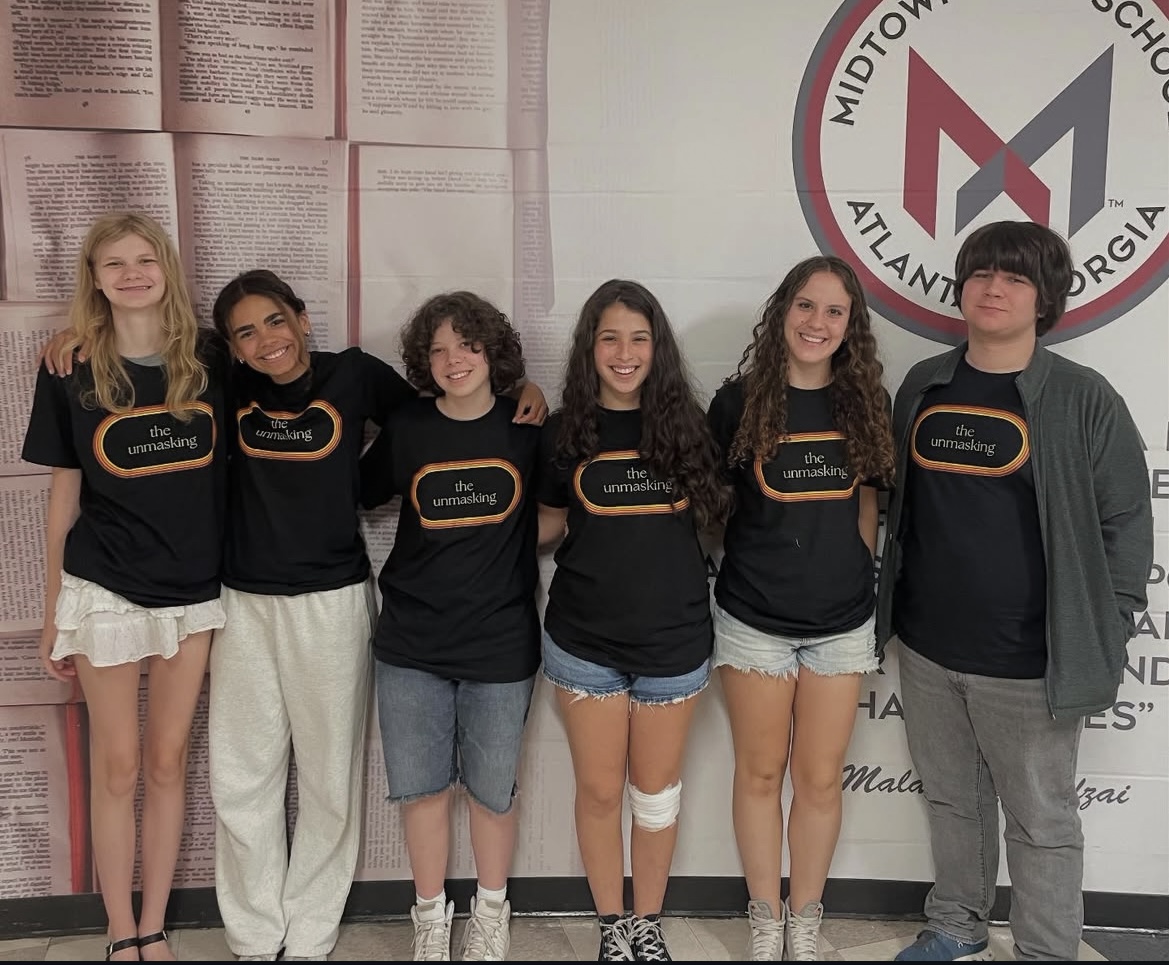
“The Unmasking,” Midtown’s student-led literary magazine showcases student art and writing, releasing its newest edition, “Relinquish,” in April.
Erin Aube, language arts teacher took over the literary magazine in 2024.
“I love showcasing the writing and art of the Midtown community,” Aube said.
Aube said Midtown has had a literary magazine since 1988, but this is her second year as the faculty adviser.
“My class this year has been amazing,” Aube said. “We focused much more on the ‘class’ aspect of Literary Magazine — exploring genres, poetic forms, story elements and figurative language devices. My favorite part has been listening to my students’ analyses of difficult texts.”
Aube said the staff started the prior year brainstorming themes and aesthetics for this year’s publication.
“This year’s theme was ‘Relinquish,’” Aube said. “We wanted to take what can sometimes be seen as a negative concept, such as surrender, and explore the positive aspects that can often come with letting go. Our book was composed of what we saw as three stages in the ‘relinquishing’ process: release, yielding and acceptance.”
Sophomore Abbie Alexander, the spread editor of “The Unmasking,” said that what stands out about the literary magazine is that it is a class run almost entirely by students.
“It’s a framework I haven’t encountered in any other class I have taken: in ‘The Unmasking,’ student voice matters and every member of the class has a say in major decisions,” Alexander said. “When a student is struggling or has questions, they turn to their classmates or editors for a solution, who provide the guidance that a teacher typically would in a normal class. It’s a way to both rely on individual skillsets and encourage people to step into leadership roles.”
Senior Thomas Brown, the head editor of “The Unmasking,” said the class focuses on the creative writing process.
“The lit mag is one of the only places in our school that gives students the time for creative writing, as well as the resources for editing and critique,” Brown said. “Most creative writing units are a few weeks, at most, and culminate in submitting a single short story to their teacher. The editing process is critical for improving as a creative writer and learning to love writing. There’s comfort in seeking your mistakes, because [everything] is a stepping stone for improvement.”
The creation of “The Unmasking” begins with student submission. The magazine opens for submissions in the second half of the first semester.
“Once the submission deadline closes, the class reviews and votes on every submitted piece, and the ones that get in begin to undergo edits from the writing team,” Alexander said. “After everything is ready, the editing team arranges the pieces of writing and art for their order in the book, trying to pair writing and art that fit the same theme.”
Alexander said the class begins every year by teaching students creative writing skills they will need later on.
“We began the year with skills training: mainly creative writing instruction and peer review of materials so we could build up a quality repertoire of staff work,” Alexander said. “Although a spot in the book is not guaranteed, most staff writers secure a poem or story in the magazine early on because of their work on poetic forms and in-class editing.”
Alexander said in the second quarter of the school year, students are divided into teams, which determine which areas of the magazine they will work on in the production process. Possible focus-areas include writing, art, social media outreach and sales. After that, each section editor teaches a lesson on their area so students are equipped to do more specialized work.
“I’m the spreads editor this year, so I was in charge of instructing everyone else designing pages, putting final edits [in] and managing logistics,” Alexander said. “Working with other people to promote their creativity was something that I really enjoyed, especially when people had out-there ideas that I could enable and ended up as a fantastic product.”
Alexander said that her favorite part of creating the literary magazine is designing the pages. Alexander said that the challenge of designing a spread is combining art and writing in a way that makes the page cohesive without taking attention from either piece.
“[Designing spreads] provides a creative challenge for me that is never the same for each page, and it’s incredibly fulfilling to see my work come to fruition at the end of the year,” Alexander said.
Alexander said the last step in putting everything together is spread work.
“Everyone on the spreads team is assigned to several pages, and they have creative freedom to design in a shared Canva [design platform],” Alexander said. “The editors tweak and finalize the spreads, and then we send the book off to print. At the very end of the year, we choose our best art and writing to go to the major literary magazine competitions: Southern Interscholastic Press Association (SIPA), Recognizing Excellence in Art and Literary Magazines (REALM), National Scholastic Press Association (NSPA), Georgia Scholastic Press Association (GSPA).”
Brown said that the process of putting together the literary magazine this year was especially streamlined.
“We tried a new rotation for each class period this year, giving us equal time to improve as writers and to work on the lit mag,” Brown said. “Additionally, we spent the first semester planning and the second semester actually putting [it] together. That planning at the start of the year gave us the foundation to put together the magazine so much faster.”
Brown said his favorite part of working on the literary magazine is making spreads.
“I like to think of it as setting the stage for a short play,” Brown said. “It is a fun challenge to extend the creative vision of a given work to the constraints of a page. I think that unique touch we give each spread is what sets ‘The Unmasking’ apart from other literary magazines.”
Alexander said the magazine was divided up into three sections that each represent a type of letting go: release, yielding and acceptance. They made this choice to further emphasize the theme “Relinquish.”
“We wanted to choose a selection of high-quality, diverse work, which we were able to accomplish due to an unprecedented number of submissions,” Alexander said. “We tried to coordinate the themes very well: using color-coded sections and standard fonts. It was important to us to create a magazine with a new level of sophistication less prevalent in some of our previous years, which we were grateful enough to accomplish with amazing writing, art and design.”
Brown has been working on the literary magazine staff for four years and said they chose the theme “Reliquish” to represent the relinquishing of the old methods in the program.
“‘Relinquish,’ was fitting for such a transitional issue of ‘The Unmasking,’” Brown said. “For a long time, even before I joined, the lit mag was just going through the motions. Interest had been down, even before the pandemic, and when [the pandemic] hit, it was rough.”
Brown said that the literary magazine was only able to sell digital copies during the pandemic and struggled with funding, so the program was shut down.
“It was a year or two after the pandemic when I joined the lit mag, and things had relatively calmed down, but we were nowhere near where the lit mag was at its peak,” Brown said. “People were too nervous to change anything too much, because that was a risk that could sink us. And then, Ms. Aube took over the lit mag.”
Brown said Aube revived the program and has been overseeing it ever since.
“Ms. Aube breathed new life into the lit mag,” Brown said. “She worked with us to organize and formalize our systems while keeping everything that made ‘The Unmasking’ unique. I will admit I was a bit uncertain about some of her approaches, but it all worked out for the best, and I will go on to college with the comfort [of knowing] that ‘The Unmasking’ is in good hands.”
Brown said the program changed significantly this year to make necessary improvements.
“We had to relinquish a lot of our old ways of doing things in favor of a lit mag that was more uniform and readable,” Brown said. “We decreased the page count and the size of the magazine, as well. However, looking at the finished product, it seems it was all for the best. The contrast between this and our last edition is striking, and [represents] the dawn of a new era for ‘The Unmasking.’ I feel honored to have been a part of this, and I wish only the best for it and its staff going forward.”