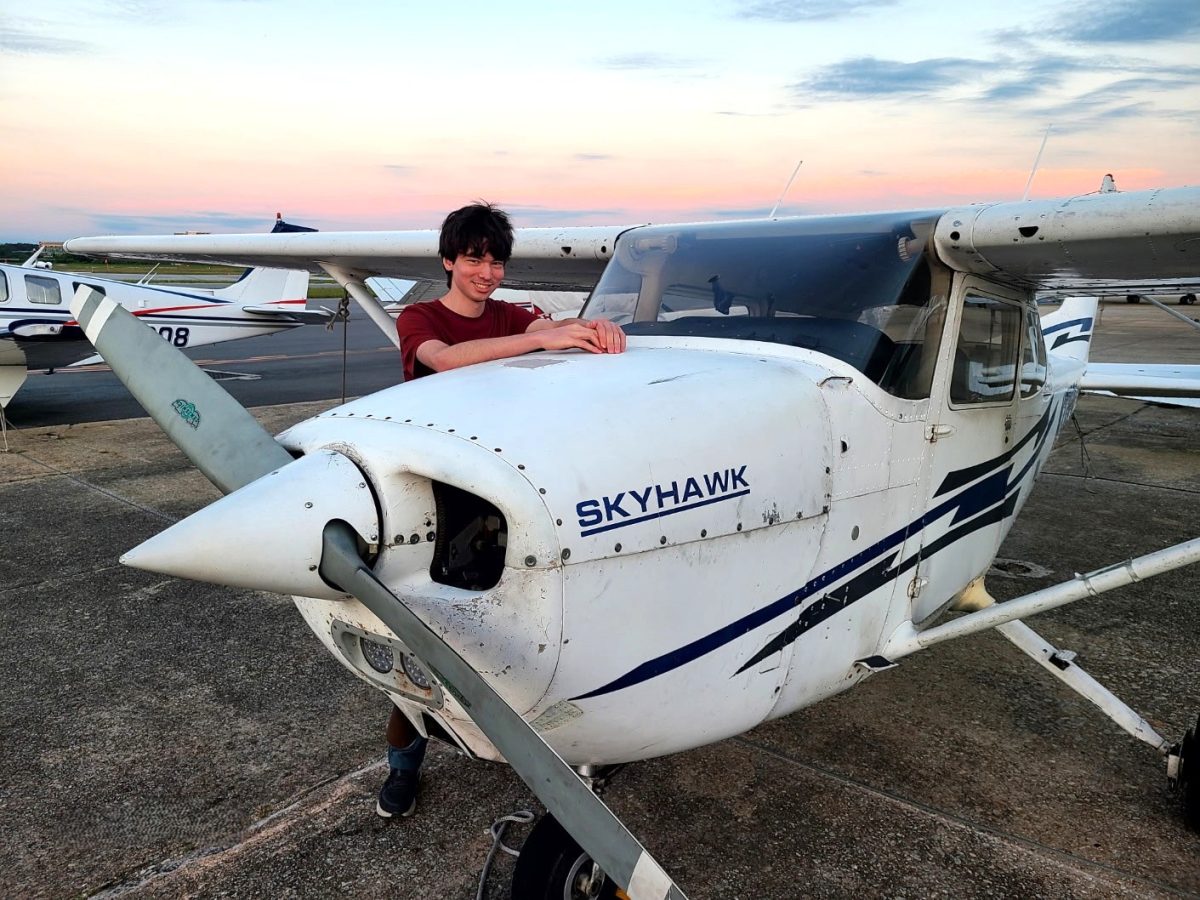
Sophomore Ronan Weyandt is on his journey to taking flight as a fully licensed pilot. Weyandt, who has been training to be a pilot since October of 2025, recently completed his first solo flight on April 10.
Weyandt takes one-on-one lessons with his private flying instructor Jack Lin. In total, Weyandt has around 28 hours logged, but needs another 12 hours before he is able to obtain his license.
“Right now, because of both work and school, [lessons are] limited to just once per week when weather is permitting,” Weyandt said. “But hopefully over the summer I’ll be able to do a lot more, since I’ll have time to work more and not have to do school at the same time.”
Weyandt initially became interested in flying when his uncle introduced him to combat aviation during the pandemic. After researching the topic on his own time, he eventually decided to start pilot training.
“I started in a Cessna 150, which fits two people,” Weyandt said. “But it was not great because both my instructor and I are kind of tall, and it was cramped. We’ve been using a Cessna 172 more recently, and that can fit four people plus some cargo in the back.”
On his first solo flight, Weyandt flew three rectangular laps around the airport. Weyandt observed that flying solo meant the plane felt considerably lighter, which made the plane climb faster.
“I was very focused and concentrated, so I didn’t spend a lot of time fully enjoying it, but it was cool to know that I was confident enough — and that my instructor was [confident enough] — to let me fly on my own,” Weyandt said.
Lin believes that flying a plane shares many similarities with driving a car, such as the principle that all participants must follow the rules of the road or airspace while remaining vigilant of factors that could lead to accidents.
“[Flying is like] driving in three dimensions plus the time dimension, plus being in a wide open field with no traffic laws,” Lin said. “There are a few places that have traffic management, like an intersection. But between intersections, just imagine it’s a parking lot and you do whatever you want.”
Weyandt noted that some of the most difficult parts of flying a plane are multitasking and keeping track of the aviation, navigation and communication aspects of flight. However, Weyandt said he enjoys this challenge.
“When you’re trying to fly from one airport to another, you have to keep the plane level so you’re not changing course or moving up and down, while also keeping track of where you are,” Weyandt said. “Some planes have GPS, but others don’t. And then at the same time, in busy areas like around Atlanta, you have to always be paying attention over the radio [to] know who [to talk to] and when.”
While flying a plane is already challenging, Lin explained that the landing adds another level of difficulty.
“[When] landing a plane, you have to pay attention to your altitude, air speed, your sink rate, your pitch angle, your flap settings, your power settings, your alignment with the runway, the wind [and] the aerodynamic effects of the plane being close to the ground versus not,” Lin said. “It’s really a juggling act.”
Lin appreciates Weyandt’s methodical approach to learning to fly. He emphasized Weyandt’s natural skill in communicating, which he believes is essential for flying a plane.
“He’s conscientious,” Lin said. “He wants to make the right decisions. Is he afraid of making wrong decisions? Sure. I think he understands how consequential it can be if you don’t do something right.”
Lin said he has also enjoyed discussing with Weyandt the physics behind flying a plane, which is something many other pilots-in-training are not as interested in.
“I very much enjoy that he’s interested in exploring and understanding the physics and science and the math behind everything we do procedurally in an air frame,” Lin said.
Weyandt’s friend and fellow sophomore Amelia De Sutter believes Weyandt’s personality would lend itself well to flying.
“At first, his interest in flying surprised me, but it made sense as he is an extremely cool-headed, dedicated person who would be able to calmly think under pressure,” De Sutter said.
Additionally, De Sutter said she can imagine Weyandt as a professional pilot due to his dedication to the pursuit.
“He seems really passionate about flying as I’ll see him reading through multiple flight manuals, Wikipedia pages and other articles in class and during his free time,” De Sutter said.
In the future, Weyandt said he looks forward to obtaining his pilot’s license. He explained that while many people with a private pilot license choose to only fly as a hobby, he is considering becoming a professional pilot.
“I’ve looked into aerial firefighting, where they drop water on wildfires in places like Canada,” Weyandt said. “There’s a very wide range of options beyond just flying commercial airliners.”
Whether he decides to become a professional pilot, Weyandt will continue to practice over the coming months to obtain his license.
“By the end of the next school year, he’ll be a private pilot already,” Lin said.