Prior to his election, President Donald Trump campaigned on being a peaceful candidate who would “end wars,” specifically the ones in West Asia. Now, just over a year into Trump’s second term, the U.S. is at war with Iran.
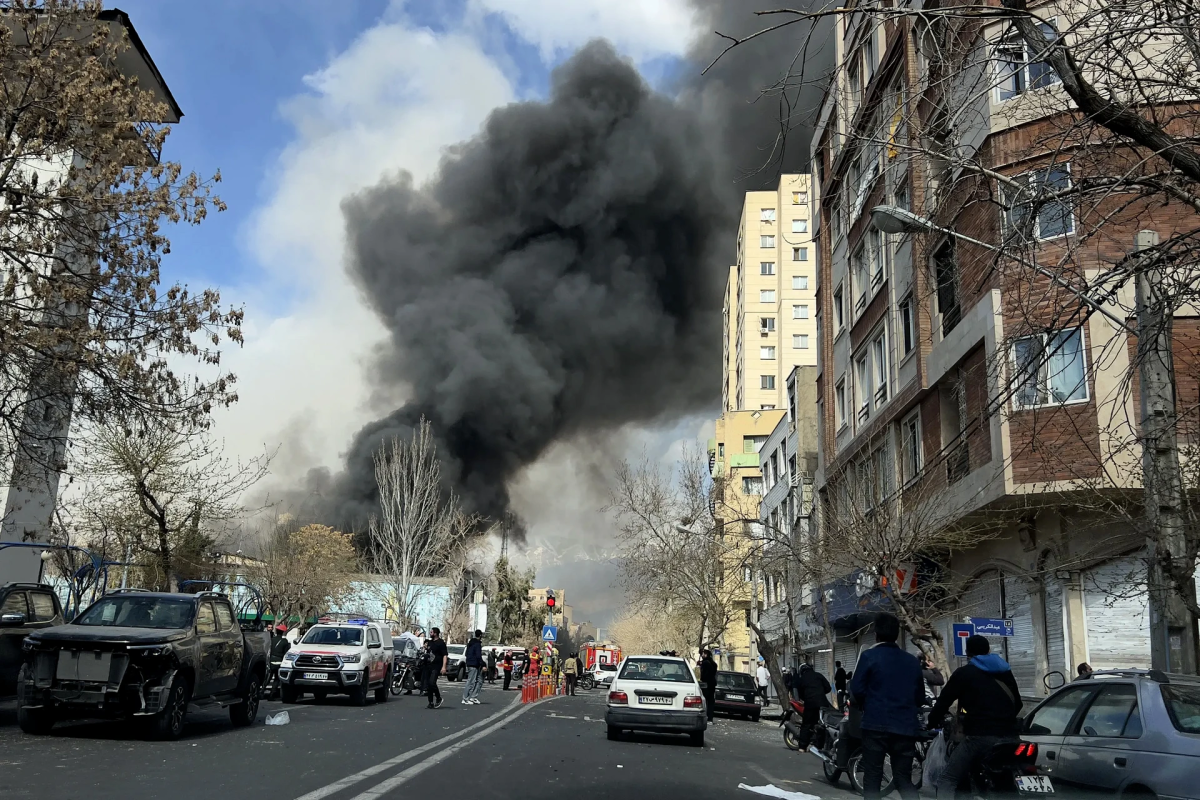
On Feb. 28, 2026, the U.S. and Israel launched a joint attack on Iran, launching missiles that destroyed nuclear and military targets across the country, and killed Iran’s Supreme Leader Ayatollah Ali Khamenei. Following the bombing, Iran launched an attack of their own, targeting Israel, U.S. military bases and other Arab states, including Kuwait, Bahrain, the United Arab Emirates, Oman and Cyprus, among others. The result of these events is yet another war in West Asia, a region with an already extremely complicated geopolitical landscape. With the war being started behind reasoning that is dodgy, at best, the U.S. and the Trump administration must handle this situation with immense care.
On one hand, the U.S. should not be involving itself in other nation’s foreign affairs to this degree. Trump called for Iranians to seize this moment to rise up and take back their nation, which indicates the U.S.’s real desire: regime change. Similarly to the situation in Venezuela, in which U.S. forces captured Venezuelan President Nicolás Maduro, the U.S. taking action to this capacity goes far beyond the limits of acceptable diplomacy. Calling for regime change also has the potential to incite violence and chaos. Additionally, the attacks are in direct violation of international law; Israel claimed the attacks were preemptive, but attacking another nation to prevent them from attacking you first is illegal.
On the other hand, if there is a regime the U.S. should spend its resources toppling, it would be Khamenei’s. He ruled Iran as a brutal, authoritarian dictator who arrested and killed protesters, imprisoned journalists and rigged elections in his favor. All the while he significantly weakened Iran’s position in West Asia and in the world, as his radical policy alienated Iran from its neighbors. At most, only around 20% of Iranians supported Khamenei, and even fewer supported his violent tactics. The Iranian people are largely glad to see Khamenei dead.
However, despite how harmful Khamenei’s regime has been to Iran and the surrounding nations, it is difficult to justify the large amount of casualties war brings, as well as the immense funding war requires. This is especially significant when one considers that killing Khamenei is not the only step in ending an entire regime that stood for 36 years. Loyalists to Khamenei and the Islamic Republic will continue to keep a hold on the nation, and without internal breakdown it would be extremely difficult to actually replace Khamenei’s government with a new one. This is made even harder by the fact that Khamenei will likely become some form of a martyr for those who believed in his ideology.
Additionally, in order to remove Khamenei’s deeply entrenched regime, the U.S. would need to deploy more ground troops to Iran. The fighting has already claimed the lives of 13 U.S. troops as of March 24, 2026, and according to Trump himself, more will likely die in the campaign that is set to follow these attacks. Countless civilians will die as a result of this war, as well, especially in a campaign that is heavily reliant on the use of missiles, bombs and airstrikes. More than 700 civilians have been killed in Iran, and nearly 900 have been killed across the region as a result of the fighting. However, this has not stopped Trump from saying he would do “whatever it takes” to make this operation a success.
But what does success in this situation even look like, and why is the Trump administration really waging this war? According to Trump, the goals of the operation are to destroy Iran’s navy, keep it from developing nuclear weapons, destroy its missile infrastructure and reduce the support Iran gives to terrorist militias, such as Hezbollah. However, Trump and his administration drastically exaggerated how much of a threat Iran poses, saying Iran was weeks away from striking the U.S. despite the fact that Iranian missiles have a range of roughly 1243 miles, which is 4970 km less than the distance needed to attack Washington D.C. For the U.S, this war much more resembles an effort to nullify an ideological opponent in a region all the way across the world than an effort to defend itself.
Ultimately, the U.S. government starting a war in West Asia behind motivations that are unclear and potentially unjustified is not a new issue, or one that is unique to the Trump administration. However, this does not make this choice any more acceptable. We have seen before how military campaigns in West Asia have ended. In a perfect world, Khamenei and his regime are removed from power, and the Iranian people can retake their government and run it how they please. However, we do not live in a perfect world, and history indicates that waging war is possibly the worst thing a government could do if they’re trying to get there.