
Atlanta hosted the 100th Olympic and 10th Paralympic Games on an international stage in the summer of 1996. Now, 30 years later, Atlanta’s Olympic and Paralympic legacy is still seen today.
The Centennial Olympic Games began with a surprise. Olympic gold medalist and World Champion boxer Muhammad Ali lit the cauldron at the opening ceremony; this moment has been noted as one of the most memorable in Olympic history. John Schmidt, Special Projects Program Associate at the Atlanta History Center, cited how this was a memorable experience for Georgians.
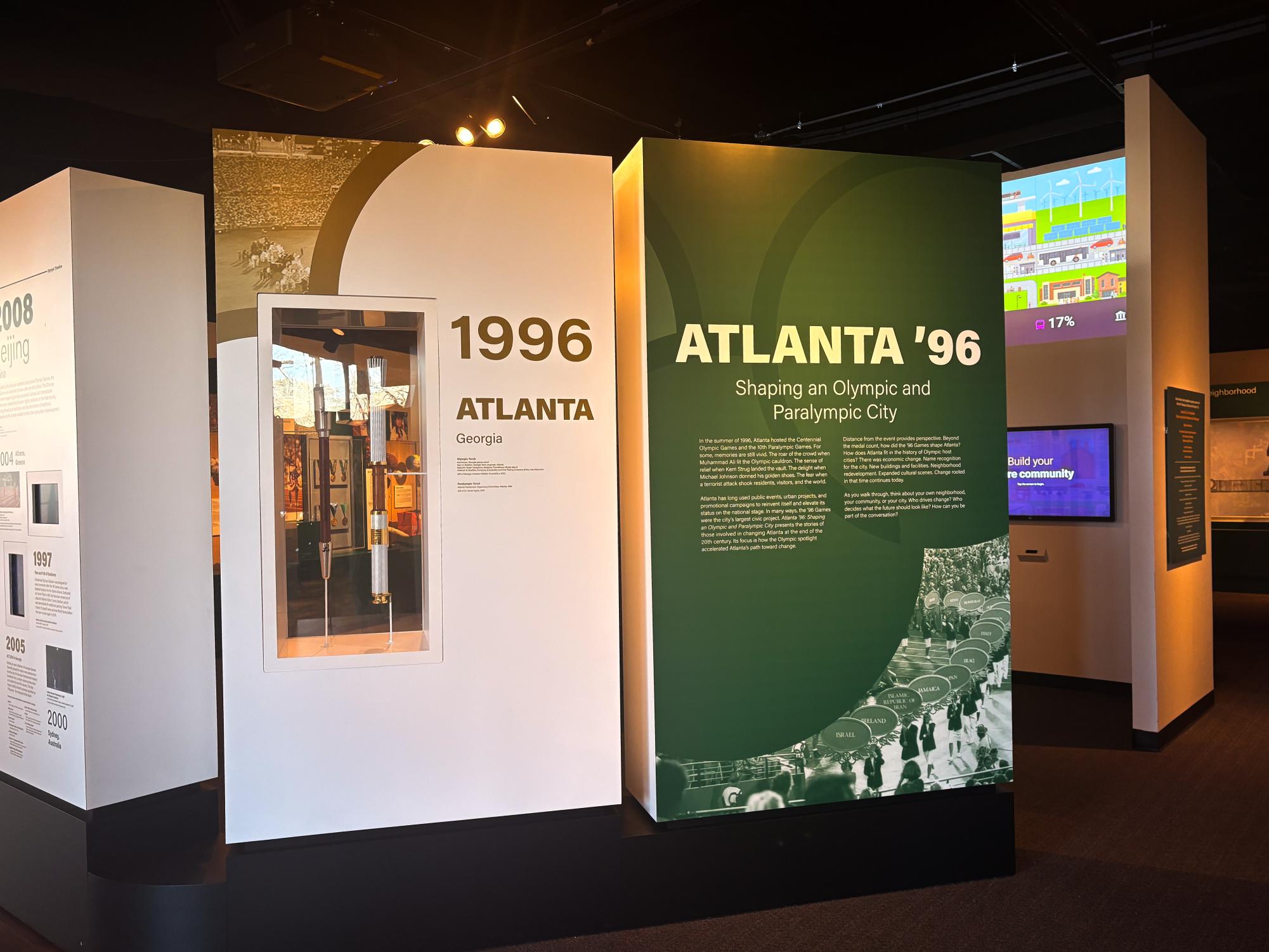
“We have almost every Summer Olympic Torch throughout the history of the Games in our collections, but in the exhibition, we place the ’96 torch front and center,” Schmidt said. “It’s an iconic image of the games; many Georgians can tell you where they were when the torch relay passed through their community, up to Muhammad Ali lighting the Olympic Cauldron.”
Associate Vice President-Central Development at Georgia Institute of Technology, Matthew Ryan, was the captain of the United States handball team in 1996. The team placed ninth in the world. Ryan reflected on the opening ceremonies.
“The opening ceremonies were pretty remarkable,” Ryan said. “It was a culmination of years of hard work, dedicating yourself mentally and physically towards a goal, and this was one more step in the journey. I’m so competitive that while I took in the amazing experience of what opening ceremonies are for the Olympics, I still had one eye on competition.”
Ryan came to Atlanta before most of the other competitors. He described what came along with arriving early.
“We were one of the first Olympic teams to move to the city of Atlanta,” Ryan said. “By doing that, you had a lot of radio stations and corporate sponsors that were looking for a way to get connected sooner rather than later, and it allowed us, a struggling Olympic sport financially, compared to a USA Swimming or Track and Field, to tap into some good resources that we typically wouldn’t have. We were doing interviews all over the city. We were kind of the voice of Atlanta and the Olympics for well over a year.”
Jean Driscoll is a four-time Paralympian who competed in the 1996 Games. She was inducted into the United States Olympic and Paralympic Museum Hall of Fame in 2011. Driscoll described the Paralympic opening ceremonies.
“The opening ceremonies usually run kind of late, and I remember being at the stadium quite a long time,” Driscoll said. “But there’s always an excited buzz around opening ceremonies. So I remember waiting behind the scenes quite a while until we got to march in, but marching into the stadium is always thrilling.”
Creating the Centennial
Atlanta faced competition in hosting the 1996 games, including from the city where the modern Olympics began.
“Going into the bidding process for the Centennial Olympic Games, Atlanta was widely seen as an underdog,” Schmidt said. “Atlanta’s bid went up against several more conventional candidates: Toronto, Canada, Belgrade in then-Yugoslavia, Manchester, United Kingdom, Melbourne, Australia and (most significantly) Athens, Greece, the original host city of the first modern Olympic Games in 1896. Many felt it would be natural for Athens to host the Centennial.”
The 1996 games turned to backing from corporate sponsors like Coca-Cola. According to Schmidt, Atlanta’s bid set a trend for future bids by utilizing new tactics.
“Atlanta won out because of a strong campaign that highlighted the city’s place in American history and promises to modernize the Games,” Schmidt said. “Led by Billy Payne and bringing in support from leaders across the public and private sector, including mayors Maynard Jackson and Andrew Young, the Atlanta Committee for the Olympic Games prepared a robust bid that touted our role as a center for the civil rights movement, private partnerships from internationally known organizations like Coca-Cola, and a sleek presentation that used the new computer boom to its advantage. Many of the techniques used became standard practice for future bids.”
Before Atlanta’s games, the bid for the Olympics and Paralympics were separate; however, the work of activists like Alana Shepherd, who helped Atlanta campaign for the Paralympics, led the International Olympic Committee to change the process so cities hoping to host had to provide plans to accommodate both games.
“The Paralympic Games were a different process,” Schmidt said. “Unlike today, cities bid on the Olympic and Paralympic Games separately, and the Paralympic Games were still relatively unknown. ACOG’s sole focus was bringing the Olympic Games to Atlanta, so local disability rights advocates formed a different committee to bid for the games, supported in part by Alana Shepherd, co-founder of the Shepherd Center. Thanks to those efforts (and an agreement from Olympic organizers to share facilities), the Paralympics were able to come to Atlanta, and the campaign (and popular mascot, Blaze the Phoenix) helped bring greater attention to the games.”
Each Olympics and Paralympics requires extensive branding. The Paralympic Games adopted the motto “Triumph of the Human Spirit,” and the city adopted “Atlanta: Come Celebrate Our Dream.” Schmidt explained the faces of the games.
“Originally short for Whatizit, Izzy was the first Olympic mascot to be entirely computer-generated,” Schmidt said. “Though controversial at the time, Izzy has become an endearing symbol of the 90’s in Atlanta and a forerunner of the more abstract mascots of subsequent Olympics. Also underrated is the Paralympic mascot, Blaze the Phoenix, which was much more positively received and was essential in marketing the Paralympic Games in Atlanta.”
Driscoll emphasized the work and time that went into planning.
“I remember feeling really grateful to everybody behind the scenes, from the people who organized the Atlanta Paralympic Games, Atlanta Paralympic Organizing Committee to the US coaches who were working with us,” Driscoll said. “I really feel grateful that there were people who were willing to be sleep deprived, and to make sure the games were a successful experience for all of us athletes who qualified to compete. I’m really proud that I got to compete in Atlanta and am really proud of the games that APOC planned for us.”
“Triumph of the Human Spirit”
Driscoll walked away from the 1996 games with two gold medals, a silver and a bronze. Driscoll noted how the track she raced on suited her skill set.
“I got one of each,” Driscoll said. “I tell people I got the whole set, but certainly gold is the goal going into the games. I was competitive in all of my events, and certainly in the marathon. I mean, I wanted to win all of the events, but I got the gold in the 10,000 meter event and the marathon in ‘96. The marathon was hilly, uh, which suited my type of course. My strength to weight ratio was very good. I had a max bench press of 210 pounds and a body weight of 111.”
In 1996, Driscoll also had the opportunity to compete in the Olympic Games. The International Olympic Committee chose an exhibition event each year, and from 1984 to 2004, the wheelchair events were on display. Driscoll said that because the IOC president, Juan Antonio Samaranch, loved the wheelchair, the showcase continued.
“During the Summer Olympic Games, there were two wheelchair exhibition events, an 800-meter event for women and a 1500-meter event for men,” Driscoll said. “It was only a final, so any of us who were vying to compete in those Olympic exhibition events had to go through a series of different trials and then be one of the top eight athletes to compete at the Olympic Games in the exhibition events. I was able to compete in ‘92 and ‘96. In those Olympic exhibition events, I won the silver medal both times, and then I went back for the Paralympic Games after those exhibition events.”
The Paralympian further cited Atlanta’s climate as something that stood out to her.
“The marathon, because of the hilly course, is the [event] that stands out to me, the 10,000-meter event too,” Driscoll said. “It was hot and humid, and I remember getting sick to my stomach partway through the race, and then I just was able to collect myself and hang on for the gold medal. But I just loved being able to compete in my home country. That was extra special. There are a lot of people who go their entire careers, and they don’t have that privilege.”
Ryan’s team ended up winning ninth in the world. When the team made it to the placement round, they knew ninth was their gold.
“It was a fast-paced, physical game, and you work your entire life to be at the precipice of this sporting experience,” Ryan said. “Even though it wasn’t for a gold medal or anything like that, it was our way we could close out our experience by giving it our all. And ninth place was now our goal, because that was gonna be our gold medal, and we ended up in the 9-10 placement game and back and forth game.
Ryan described the final win, and what that meant to him.
“We ended up against Algeria, and it’s at the end of regulation tied, and so we go into overtime, and there’s a dead ball,” Ryan said. “There’s one opportunity to enter the ball back into play, and we score on this dead-ball nine-meter shot that has about a one in 100 chance of working. This little gimmick play we did worked, and the six-foot-seven Air Force Academy grad threw it over the defenders from Algeria by the goalies and the goalie, and we walked off with a last-second win and ran around the stadium and ripped off our jerseys, jumped into the crowd, as if we had just won the gold medal or beat the Russians in hockey. It was that special for us, and that will forever live in my memory.”
Driscoll described the work and effort it takes to compete, offering advice to young athletes.
“When I sign my autographs, I sign ‘dream big and work hard,’” Driscoll said. “You have to put the work in. You can’t skip workouts. You can’t cut workouts short. You’ve gotta put the time in, and you have to be committed to the sport in order to even have a realistic chance of making a Paralympic team. The hard part is really important, but dreaming big, seeing yourself, doing great things is also an important part of becoming a Paralympic athlete. There’s a saying, ‘Believe it, achieve it’, and I think dream big and work hard is probably the most succinct, but powerful advice I can give to young athletes.”
Centennial Olympic Park Bombing
On July 27, 1996, a 40-pound pipe bomb went off in Centennial Park at around 1:20 a.m., causing the death of two people. President at the time Bill Clinton denounced the explosion as an “evil act of terror.”
The games went on as planned following the attack. Schmidt cited an article by Maria Saporta in the Saporta Report about her perspective on the reopening of the event.
“The tragic bombing in Centennial Olympic Park cast a sadness over the Games,” Saporta said. “But when the park reopened several days later, it was one of the most uplifting moments of a city and an international community coming together for the forces of good winning over the forces of evil.”
Ryan was staying in Olympic Village during the time of the bombing. He described his recollection of being told what happened.
“We were woken up around five, 5:30 in the morning, and all congregated into a meeting point, and they shared with us that we need to check on our loved ones, and there was a bombing,” Ryan said. “It was very alarming because I knew that the hospitality venue for the Olympic athletes and their families was right where this happened, and it became very, very alarming, and we didn’t have cell phones to deal with back then. We just had pagers. And so we’re able to send notes via pagers to family, or when we got to a phone, we’re able to call them early and find out the impact that this may have had on them.”
Ryan described how the bombing affected the Olympics from a logistical standpoint, emphasizing the increased security for athletes.
“The tone changed,” Ryan said. “There was heightened security all around, specifically for the U.S. teams. And we were a team that had military coaches, people from the West Point Academy and Air Force Academy on our team, and so we were deemed high risk or high visibility to potential terrorist activity. We had four US Marshals on our buses. We had security vehicles on the front end and the back end of our buses as we went into and from practice or the venues for competition, and we had helicopter security as well during all this.”
“Atlanta: Come Celebrate Our Dream”
Many of the improvements and buildings Atlanta had to build to host the games are still seen throughout the city today.
“The infrastructure needed to host the Games can still be seen today – we created an online tour of all the stops you can visit that were used for the Olympics,” Schmidt said. ”As the city shaped itself for the arrival and operation of the Games, many Atlantans felt a stronger sense of community and civic pride.”
Ryan described what Midtown Atlanta looked like during the Games.
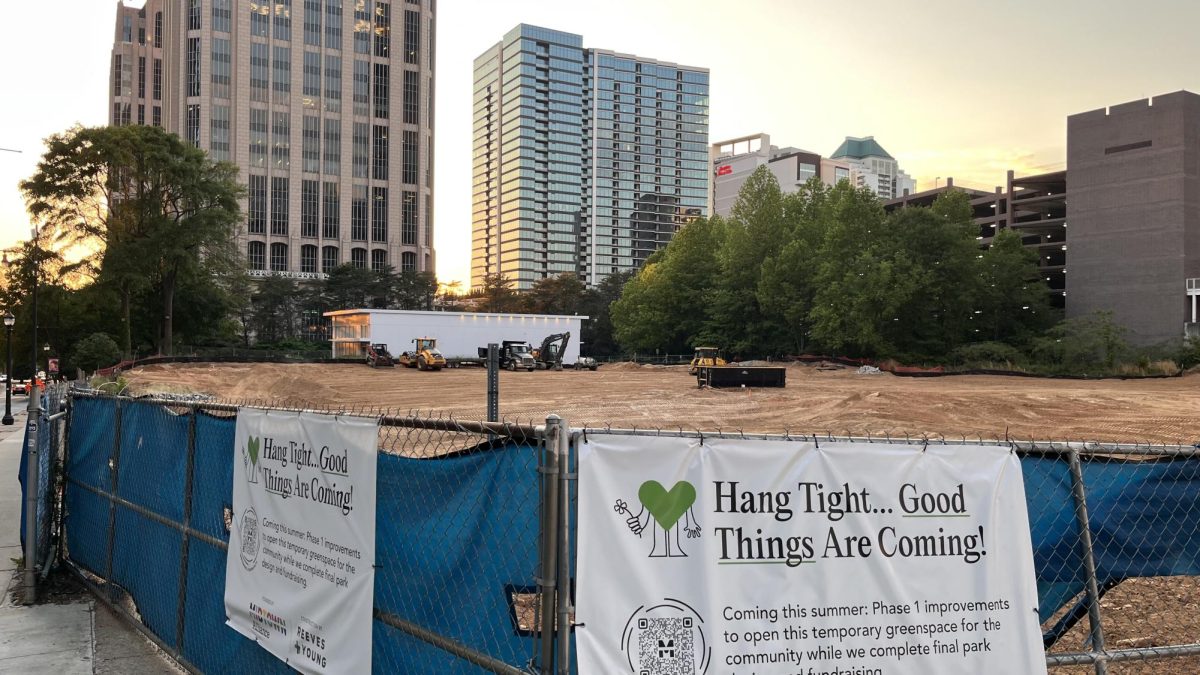
“I look at Midtown, and what it looks like now, compared to what it looked like then,” Ryan said. “It was just empty lots across the 5th Street Bridge and 10th Street, and those were staging areas for processing athletes to come into the village. Once we got in, it was kind of like looking at a who’s who of athletes. You’re seeing some of the top basketball players in the world and track and field athletes, and as we got to our dorm, I went up the elevator with two professional tennis players…They were just like me, going to a dorm room and going to be eating the fine cuisine of the Olympic cafeteria.”
It wasn’t just buildings or parks that remained from 1996; Ryan emphasized the relationships that he still has with his Olympic teammates.
“I was fortunate to be captain of the team and that remains true to this day,” Ryan said. “30 years later, I’ve coordinated one, five, 10, 15, 20 and 25 year reunions. Each reunion, it’s another person married, another kid born, another transition into another job, and now to see where everybody is today, and the success they’ve had is quite, quite special. I’m not sure everybody’s outcome from the Olympic Games in high school or college is so tight that you’re still staying very tightly connected with all these special people, but we do, and so that just adds to the experience through good times and bad times.”
Georgia Tech recently opened an exhibit at one of its libraries showcasing artifacts, videos and other memorabilia from the 1996 games. Ryan attended the opening of the exhibit and pulled on his Team USA jacket for the first time in 30 years.
“It was still fit, there was just a vibe and an excitement and a chill that I just didn’t expect,” Ryan said. “It struck me in a way that was very emotional, hairs standing up and giving me chills to reflect on what was a special time in my life.”