This year, Virginia-Highland Elementary School (VHE) launched its Writing Club, created to showcase young writers and to encourage their creativity. The students in the club will write different literary works throughout the year and design visual elements to be published in a new literary magazine.
The club was cofounded by third-grade humanities teacher Zachery Ward and media specialist Taylor Klinefelter. Their goal was to give students a new creative outlet.
“[We] wanted to give VHE kiddos an opportunity to express themselves through writing,” Ward said. “Some kiddos would rather share their thoughts in other ways than speaking or being on stage.”
The club meets every Wednesday after school. This is when the majority of their work is done.
“Our writing club meets on Wednesday afternoons,” Klinefelter said. “We start by reviewing assignments and having a snack, and then students go off to work in their groups. We have two Editors-in-Chief who check in with the groups as they are working and [Ward] and I float between groups as needed.”
Students are given a choice of what kind of writing they want to work on, ranging across a scope of issues. Some ideas they have suggested include, non-fiction, recipes, poems, comics, fictional stories and Question and Answer segments.
“For the first issue, we’ve divided students into four teams,” Klinefelter said. “One group is focused on fiction; one is writing informational pieces by interviewing teachers and covering school events and one is writing smaller features like puzzles and games, jokes, recipes, craft projects and poems. The fourth group is working with visuals.”
In addition to the literary works featured, the students are also participating in the design process for the magazine itself.
“I am doing the bulk of the layout and design for our first issue using Canva,” Klinefelter said. “We have a 4th grade student serving as our ‘Canva Expert’ who is helping me with choosing colors and designs. Another 4th grader is our primary Copy Editor, who will be helping students with general spelling, punctuation and grammar editing.”
The magazine is also providing an outlet to students who are nervous to share their writing out loud, helping them slowly build their confidence.
“A lot of students do not like sharing their writing out loud, but having it as part of a magazine makes it easier,” Klinefelter said. “We work with them in small groups or one-on-one, so they can polish their product before sharing. That helps with nerves.”
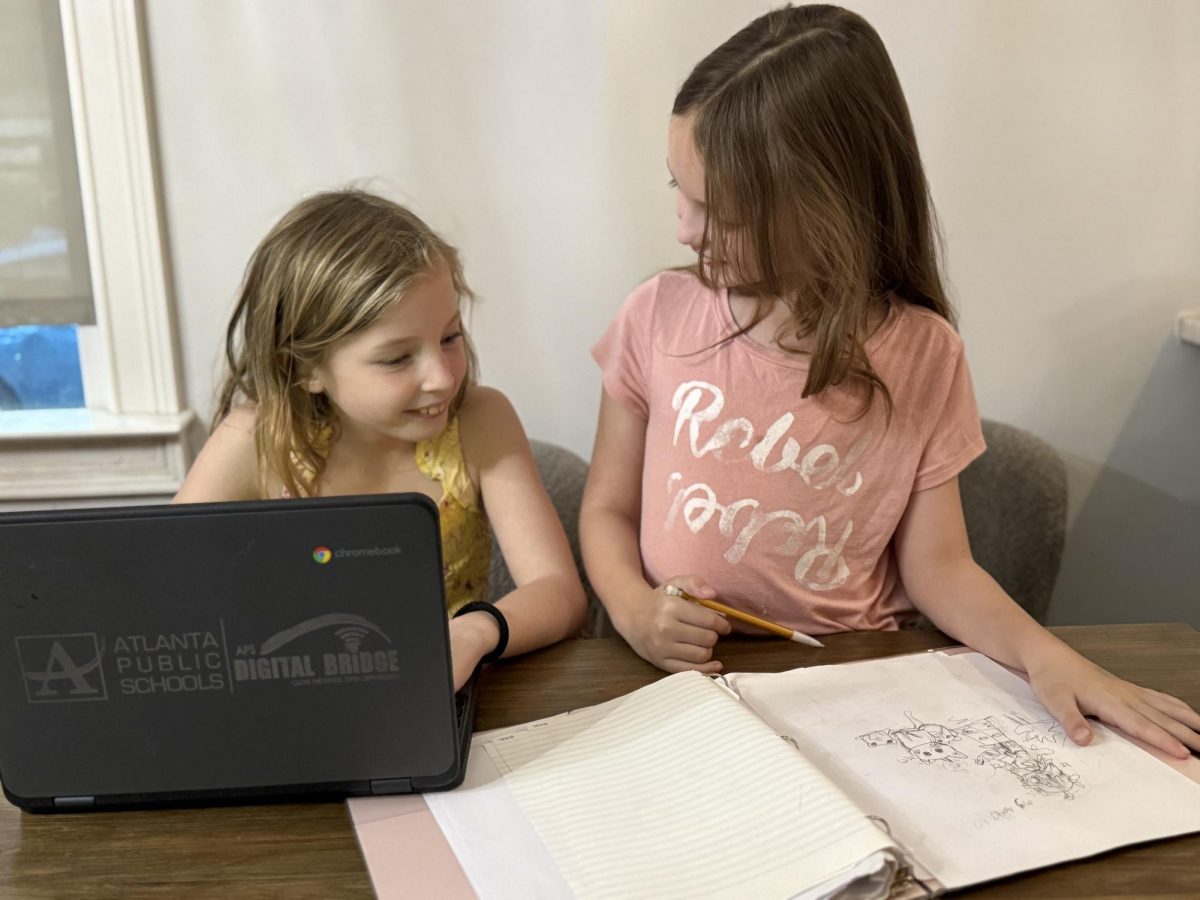
Third-grade club member Abby Sewell said she’s excited to see the magazine once it’s completed. Sewell is in the fourth group, and her team has been focused on drawing comics and writing jokes.
“Other groups are doing interviews, stuff about what’s going to happen soon in the year like the book fair and some people edit to help with punctuation and capitalization,” Sewell said.
Ward said student literary works will be highlighted through weekly emails from homeroom teachers to parents and guardians. Student writings will also be featured in a print literary magazine. While Writing Club students will produce a majority of this work, they won’t be the only students featured.
“We plan on giving all students the opportunity to submit writing that will then be reviewed by our editors,” Ward said. “This will give an opportunity for all VHE students, not just those in writing club, to be a part of our literary magazine.”
Sewell said she wants to be an artist once she grows up, so she has enjoyed drafting comics and writing stories during Writing Club.
“I enjoy writing the stories a lot,” Sewell said. “We also get to work as a team, which is very fun. I’m really excited to see the magazine because I just want to see what the other groups have been doing.”
Sewell’s mother, Elizabeth Sewell, said she enjoys watching her daughter grow and do something she loves.
“Abby enjoys learning to be a better writer and doing an activity with her friends,” Elizabeth Sewell said. “I love that she’s learning a life skill in a way that’s fun.”
Ward said that he has noticed club members’ growth. He’s looking forward to publishing the first issue because he thinks the students will be proud of their work.
“We have noticed that the members of the Writing Club have become a bit more passionate about writing,” Ward said. “We’ve noticed an increase in organization. It also is giving these students an opportunity to be [leaders].”
Klinefelter said that inspiring a love of writing in students is critical to encouraging them to continue to write and express their creativity.
“Because of the standards we teach, students spend a lot of time writing informational, persuasive, and personal narrative texts,” Klinefelter said. “Because of this, students often get excited when they have the opportunity to write fiction. Much like with reading, exposure to lots of different genres and types of writing makes it more likely that students will continue writing in the future if they find something they love to write.”