
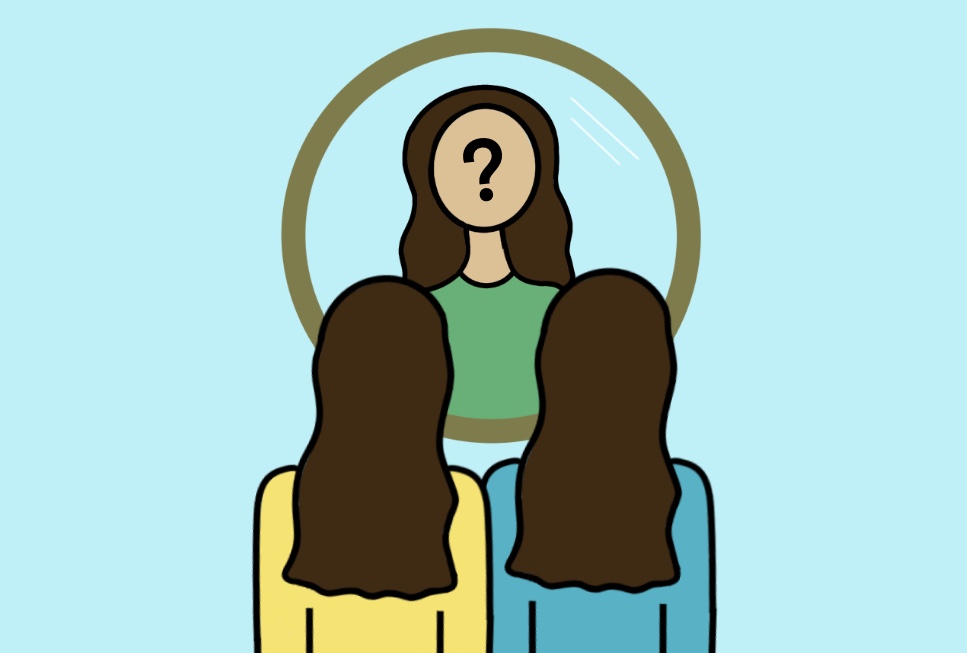
“Do they like me for me, or do they think I’m her?”
When people see us, their first question is often, “What’s it like being a twin?” Of course, we respond with the positives: being a twin provides a confidant and best friend. However, what many people do not realize is the coinciding feeling of self-doubt that comes with having a twin. It is the weight of comparison: an uphill climb, heavy on each of our shoulders and our persons.
In our lives, there have been very few moments when we are separated. It has always been “Dylan and Reese.” We share everything: our struggles, our successes and also our desire for individuality.
Individuality and identity means something different to every person. To us, our individuality is found in how we carry ourselves and our identity begins with our names.
We are accustomed to responding to both of our names. Confusing our names is not an issue; it is understandable. When this happens and only one of us is present, we can’t help but think, “Did they want her to be here instead?”
Being recognized as our counterpart is like a shield, where we are temporarily protected from our own fears and insecurities. It’s a combination of relief and sadness. It’s the feeling of a shared difficulty and triumph. However, at a certain point, there is a fear of not being recognized as individuals. As twins, we strive for our own identity, with separate feelings, interests and values that guide our hearts.
However, people make choices. When people decide their favorite twin, it often comes down to who is kinder, smarter or simply the “better” twin. Assigning labels is a constant, yet something that is ever changing. It goes back and forth. That feeling connects us: the ideas of others projected onto our self-worth.
It results in an everlasting cycle of overthinking and a loss of energy and self-confidence. How should people differentiate us when we are so alike? How do we find ourselves without one another? Because we are so often mistaken, do those mistakes take away from our individual identities?
Those unintentional mistakes are inevitable and always forgivable. Yet it’s the assertions, assumptions and speculations that stick with us constantly, shaping our perception of reality.
Often, when we meet someone, they ask a seemingly harmless question— something along the lines of “Which twin is the mean one?” or “Who is the fun twin?” When this happens, you subconsciously consider the idea that they have already decided for themselves. We tend to wonder if it is our similarities or our differences that drive these comparisons.
We are undoubtedly similar— sometimes creepily so. Despite being in separate testing rooms, we achieved the same score on our PSAT, down to the exact point breakdown. We share our taste in music and our tendency to speak in unison. We share our mannerisms and expressions; we share laughter and we share joy.
However, we are undoubtedly different. Our aspirations, our goals and our personalities are distinctly our own. Still, our victories within self-discovery drive our comfort as individuals.
It is the small victories that have the largest impact on our confidence. Upon being recognized as uniquely Dylan and uniquely Reese, we feel encouraged to act as ourselves without restraint.
That said, individuality is not something to be taken for granted. Understanding your identity begins with individuality. To have it recognized is a gift not guaranteed: a feeling likely foreign to those not born a twin.
In our experience, when you are deprived of individuality, it is harder to understand who you are, the things you want and the things you believe in. It is as if you have been granted a single, conjoined identity where the lines between you and your counterpart blur. Breakthroughs in that norm are impermanent, but of immense value to us.
Being a twin is one of the greatest privileges of our lives. It’s not everyday you come across the person who completes you. Having that said, one of the biggest struggles we face is finding ourselves without each other. While we are complete together, we are certainly not incomplete apart. Our struggles contribute to a perpetually evolving narrative.
Society often expects that we must be the same or opposites— nothing in between. For us, our identities build upon each other, but our personalities have distinct differences. Still, we coexist. One person is not a reference for the other, but together we rely on our relationship in light of challenges.
We, as individuals, strongly value the relationship we have. As twins, there is no doubt that we struggle, but at least the burdens we have are the burdens we share.










Barbara • Dec 4, 2025 at 10:57 pm
Although visually hard to tell Reese and Dylan apart, spend a short time with each and you will see their individual talents and styles.
How kind of you to share your joys and challenges as identical twins. Thank you both for a well written article.
Tracy Stein • Nov 22, 2025 at 3:15 pm
This jointly written article is revealing and insightful and uplifting and courageous. Thank you for sharing your insides and being willing to talk about what is good and what is hard. And you know, rock bottom, you two love each other.
Liz • Nov 21, 2025 at 9:52 pm
What an incredible story that highlights both the joys and struggles of being a twin. You two are incredible!!