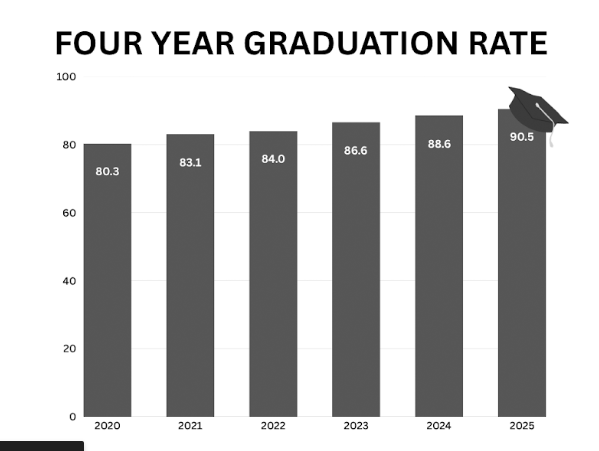
The Atlanta Public Schools Class of 2025 achieved a graduation rate of 90.48%, a 1.9% increase from the previous class. Additionally, the district surpassed the state average of 87.2%.
“Approximately [13] years ago, Georgia switched from having a graduation test to the CCRPI, the College and Career Readiness Performance Index, and started calculating graduation rates,” APS Chief Performance Officer Dr. Kathleen Howe said. “Ever since the start of CCRPI in these calculations, it’s the first time that [APS] has surpassed [90%].”
In an increase from the Class of 2024, Black students achieved 89.08% graduation, a 2.6% increase, economically disadvantaged students achieved 88.91% graduation, a 2.17% increase, English learners achieved 82.6% graduation, a 0.15% increase, and students with disabilities achieved 83.1% graduation, a 3.28% increase, achieving an all-time record graduation rate.
“It’s great when you see that overall composite store, but then when you look, and you see the subgroups and see that they too are making progress, that’s really encouraging,” Dr. Howe said. “I think success breeds success. So, every good news story matters because if we can do it for this particular group, then that gives us motivation and encouragement that we can do it for another. We can replicate that success and contribute to [the district’s] overall [success].”
Individually, 11 of 16 APS schools exceeded 90%, including Midtown. Midtown graduate Margaret Tsianti believes her class’ determination is reflected in its graduation rate.
“The Class of 2025 was ambitious from the start, making it evident that the percentage would be high,” Tsianti said. “Everyone wanted to reach their goals.”
APS saw 3,095 on-time graduates, the highest number of graduates since the implementation of the CCRPI in 2012.
“We want to continue to see our students meet and exceed the requirements to be graduates,” Supt. Dr. Bryan Johnson said. “We want to continue to improve the graduation rate. But more important than that, we also want to see more of our students be really clear about how to access their next step. And whatever their next step is … we want our students to be really clear on what the requirements are, what they need to do, and how to go about it.”
According to Dr. Johnson, APS has prioritized student attendance.
“Post-pandemic, in particular, all school districts across the country have experienced some level of challenge with chronic absenteeism,” Dr. Johnson said. “Atlanta Public Schools is no different. We’re excited to see [absenteeism] trending in the right direction. When [students] are present, it makes a world of difference versus when [they] are absent.”
The district has worked to improve transparency with the community, Dr. Johnson said.
“We’re placing a major emphasis on our students being present and our families knowing what the expectations are and the requirements,” Dr. Johnson said. “[For] our teachers and schools, [we are] making sure that we have as engaging material as possible, and high-quality instruction taking place in the classroom to make sure that when we get the student in the class at the school, that we make it as impactful as possible.”
Dr. Howe believes the district’s evolving and adaptive nature allows it to support growth and achievement.
“It is being a learning community, working to replicate what’s working and constantly being open to new ideas, programming, ways to get students motivated to come to school, stay in school, and really listening to you all — listening to students, listening to parents, getting great ideas and responding to feedback is what’s going to make us all better and stronger,” Dr. Howe said.
As district graduation rates increase, APS continues to work toward 100% student graduation, Dr. Howe said.
“We’re at 90.5% for a four-year graduation rate,” Dr. Howe said.?”We’re not going to rest until we get 100.”
Midtown surpasses 95% graduation rate
Midtown achieved a graduation rate of 95.34% with the Class of 2025, surpassing the Class of 2024 by 2.56%.
“When I look at our graduation, I feel confident that it represents an accomplishment on behalf of the staff and students,” Student Support and Programs Specialist Dr. Cheryl Nahmias said. “Even as we have been growing, the supports we have in place have supported the growth in student population.”
Dr. Nahmias believes early support is integral to student success.
“We are really focusing on ninth-grade core classes,” Dr. Nahmias said. “We are teaching executive functioning skills that will help them become more academically successful earlier — that way, they can be fully confident as seniors. Ninth grade is really the key to graduating … If Midtown will continue to grow and expand, it will be about focusing on students in their early high school career.”
Teachers have administered unit recovery classes, alternative and online education options, a student math center and Saturday school. Additionally, faculty members offer guidance to students in need of additional support.
“At Midtown, it truly is a team effort when it comes to helping students reach the finish line,” Dr. Misty Bryant, graduation coach, said. “Our counselors, teachers, and support staff work closely together to make sure students have the support they need academically, socially, and emotionally. We stay on top of their progress, meet regularly to discuss students who may need extra help, and take pride in recognizing the progress our students make along the way. Everyone plays a role in making sure no student slips through the cracks.”
Class of 2025 graduate Anna Hutchinson, believes opportunities at Midtown, such as Advanced Placement courses, prepare students for post-secondary experiences.
“I think Midtown does a really amazing job at encouraging many different paths after high school, not just typical four-year colleges, and provides opportunities for all of those paths, as well,” Hutchinson said.
Similarly, Tsianti said she felt supported through the school’s initiatives.
“Midtown actively tried its best to see its students succeed, from email newsletters to workshops and info sessions, all of which provided valuable information for college,” Tsianti said. “Graduation is a key factor in determining future opportunities, as it marks the first step towards more significant opportunities for students.”
Dr. Bryant hopes to see continued growth for future graduating classes.
“I would like to see us continue building on the strong foundation we already have in place,” Dr. Bryant said. “Our team works hard to support students early and consistently, and I want to see that continue to grow, especially in helping students connect what they are learning to their plans after high school. We have made great progress in creating more awareness around college, career, and technical pathways, and I hope to see that momentum continue so every student feels confident and prepared for their next step after graduation.”
Future Opportunities
The goal of APS is to empower students to pursue graduation and postsecondary opportunities, Dr. Johnson said.
“Graduation is a gateway to all other things postsecondary, whether it be going directly into the workforce or going to a two-year or four-year institution,” Dr. Johnshon said. “Ultimately, we want our students to be enlisted, employed or headed to a postsecondary institution … That 90% represents that more of Atlanta Public Schools’ children and students, graduates, are [ready] to take that next step.”
According to Penn Foster, research suggests that a high school diploma can aid graduates in entering the workforce or pursuing further education.
“Education is the great equalizer,” Dr. Howe said. “And students not only need, but they deserve to have choice-filled lives. And so by earning a high school diploma, it positions students in the best light, and it doesn’t matter what their zip code is, what advantages or disadvantages they may face. It’s really an equalizer.”
Dr. Namhias believes skills learned in high school translate into postsecondary success.
“Many people will tell you that the skills they most value in students are the skills that underlie being successful and reliable in high school,” Dr. Nahmias said. “Being able to organize, being able to think critically, showing up everyday – I think a lot of kids miss the point that some of the biggest predictors of their future success are fairly simple, but hard things … Those are the things that will prepare you to do well no matter what you choose. It is not about remembering [the information] you learned; it is about applying the skills you learned.”
Dr. Johnson believes high school provides students with formative opportunities as they transition into adulthood.
“[High school] is the highest level of independence that you have in your K-12 experience and the highest level of accountability and responsibility,” Dr. Johnson said. “I think to the extent that our district can continue to work to make sure that those experiences are more robust and more meaningful for students, the better we will be as a district, the better students will be as individuals and citizens, and the better our communities will be in the years ahead. [Graduation] is a critical foundational component that really sets the strong launch pad to adulthood and to be world changers.”