Naming or dedicating something to a person serves as a way to preserve their memory and legacy in a positive light. These dedications suggest that the person who is being honored must have accomplished something beneficial to others. However, this is often not the case: across the U.S., landmarks and buildings have, in fact, been named for controversial historical figures.
While many administrations have resorted to renaming their properties to be less offensive, buildings with controversial titles still remain scattered across the nation. In November of 2021, it was decided by the Georgia Board of Regents that 75 buildings in the Georgia Public Schooling System would not be renamed, despite being titled for figures associated with white supremacy, segregation and slavery. These buildings include Talmadge Auditorium, Joseph E. Brown Hall and LeConte Hall, among many others. This decision still remains, proving the need for educational measures to be taken to teach history accurately, as well as the need to rename these properties.
However, some institutions have changed their names to reflect progress towards a more righteous image. In 2020, Atlanta Public Schools voted to rename schools within its district, specifically changing Henry W. Grady High School to Midtown High School and Joseph E. Brown Middle School to Herman J. Russell West Academy. Additionally, Carl G. Renfroe Middle School, which is a part of the Decatur City School District, was renamed to Beacon Hill Middle School.
Despite the change from Grady High School to Midtown High School, Grady Hospital in Atlanta remains named in his honor, despite Henry W. Grady’s promotion of white supremacy. While progress has occurred, it is evident that change still needs to be made.
In addition to local institutions, multiple nationally renowned establishments are named in honor of controversial historical figures. Notably, Carnegie Hall in New York City is named after Andrew Carnegie. Carnegie, who was known for his work within the steel industry, famously cut the wages of his workers and infringed upon the rights of unions. His sponsorship of Carnegie Hall helped to reframe his accomplishments in a positive light, despite his anticompetitive or exploitative actions within the labor industry.
Despite recent progress, controversial titles continue to be implemented. Since the beginning of Donald Trump’s presidency, multiple buildings have been renamed in his honor. This honor, however, is typically given to presidents after they have completed their term. That said, these buildings include the John F. Kennedy Memorial Center for the Performing Arts, now renamed to the Donald J. Trump and John F. Kennedy Memorial Center for the Performing Arts. This decision was voted on unanimously by a board of trustees selected by Trump himself.
This building once served as a memorial for John F. Kennedy, representing his legacy and his service as president. Now, however, it is honoring President Trump, whose presidency has virtually no relation to that of Kennedy’s. Beyond that, their views are drastically different. While Kennedy supported the implementation of medical care benefits, Trump’s ‘One Big Beautiful Bill’ cut more than $1 trillion from healthcare programs, causing an expected 10 million people to lose coverage on their health insurance. Associating one’s self with the accomplishments of others does not erase the occurrence of problematic past events, and Trump’s crimes do not simply disappear because his name appears on a prestigious institution.
Trump has also renamed the U.S. Institute of Peace to the Donald J. Trump U.S. Institute of Peace. The USIP, which aims to inhibit the occurrence of violent international conflicts and rectify them altogether, is now named in honor of a convicted felon of 34 counts who has adamantly insisted upon acquiring Canada and Greenland, and has sparked numerous international conflicts.
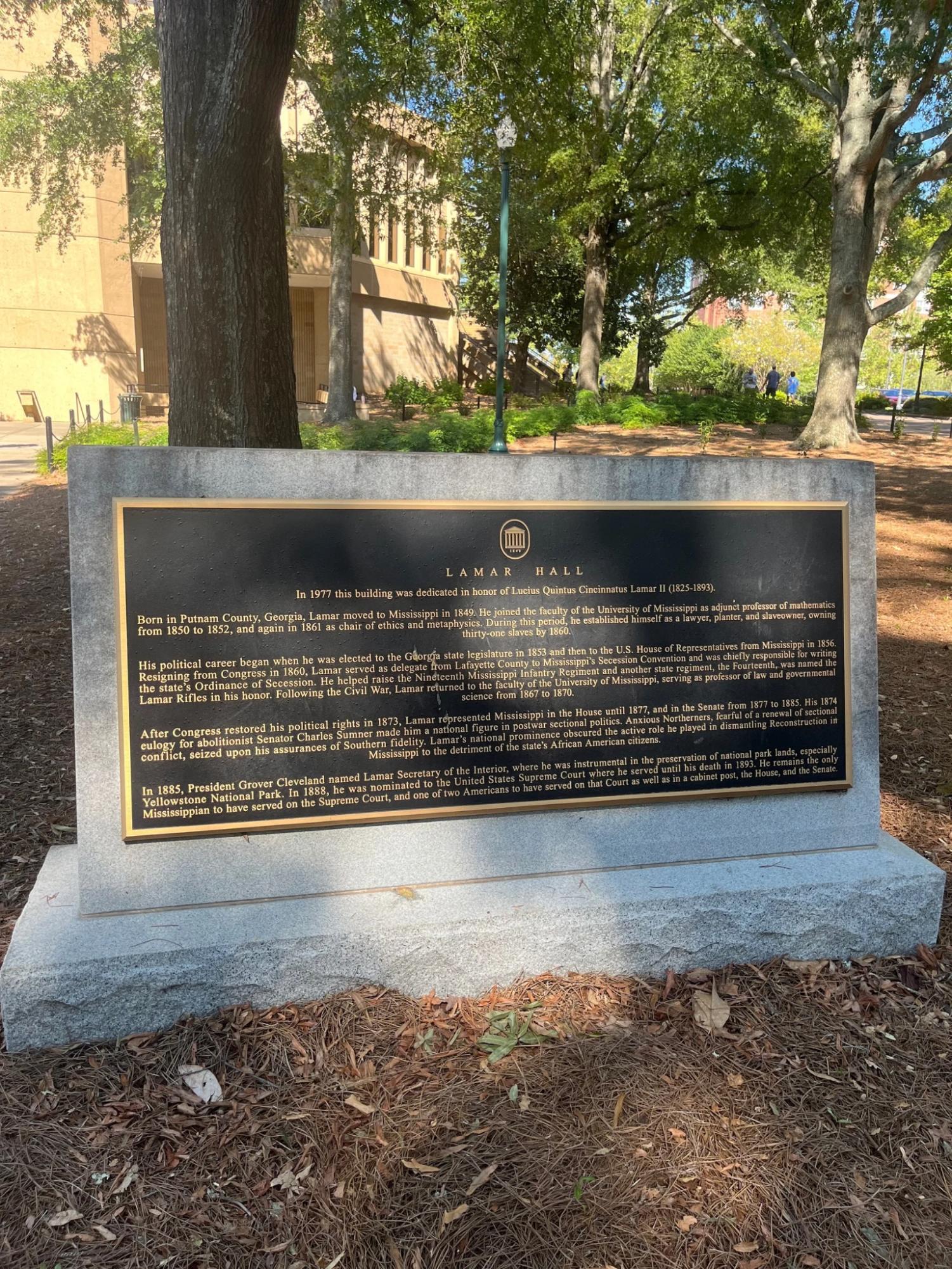
Nonetheless, there are multiple ways to address buildings named after controversial figures. In order to address these titles, the University of Mississippi added plaques that include an educational context to multiple of its buildings, preserving the history behind them truthfully. These plaques serve as a reminder of the past, ensuring that it is not forgotten or repeated.
Because it is incredibly difficult for every building on campus to be renamed, Mississippi’s implementation of these plaques represents a necessary step taken to move away from falsely revering these honorees. These plaques serve as a solution by portraying these figures as they were, rather than contributing to a false narrative of the person’s accomplishments.
Ultimately, when renaming a building or institution, it is necessary to consider the implications that may occur as a result. While renaming something serves as a solution to addressing the controversy surrounding it, implementing educational programs can allow a building’s history to be preserved without compromising its ethical integrity. Furthermore, educational programs, like the University of Mississippi’s plaque system, are necessary to accurately portraying the history of a building without falsely portraying its honoree. While changes still need to be made, these implementations are a step in the right direction.