Exploring Atlanta’s Black history through hidden figures
Atlanta has been a pivotal city in exploring African American history, cultural innovation and social change. Nicknamed the “capital of Black Mecca,” it has served as a hub deeply rooted in the Civil Rights Movement, the legacy of Historically Black Colleges and Universities and historical impact.
This February marks 50 years of celebrating Black History Month, or what some refer to as Black Excellence Month. Senior Kaili Stith, president of the Black Student Union at Midtown, enjoys Black Excellence Month through supporting black owned companies.
“We focus on black excellence month,” Stith said. “So we bought from black owned brands. We go to black restaurants, black owned restaurants and we uplift black voices, entrepreneurs.”
The BSU at Midtown is a place where black students can find community and volunteer opportunities.
“It’s very different from other clubs where we literally just exist, like we’re just black students at Midtown having fun and engaging with each other,” Stith said.
In 1881, Morris Brown College was founded in honor of the bishop Morris Brown, in an attempt to educate Black students after the Civil War. It was the first higher education institution in Georgia to be owned and operated by African Americans.
Charlene Wilhelmsen, a Midtown parent and Morris Brown College alumna, reflects on her appreciation for the history and significance it has offered her.
“As a Brownie, we take immense pride in our college, established by African Americans for African Americans at a time when opportunities for individuals of African descent were scarce,” Wilhelmsen said. “Serving as a model of self-determination, courage and perseverance it exemplifies the belief that success is achievable for all. This is the significance it holds for our community.”
Wilhelmsen reflected on the college’s ongoing efforts to preserve and honor African American culture, such as the revitalization of Fountain Hall.
“One of the recent endeavors to preserve African American culture and heritage involved the revitalization of the iconic tavern atop Atlanta’s ‘Diamond Hill,’ Fountain Hall,” Wilhelmsen said. “This historic building once housed W.E.B Du Bois’ office, where he created his influential work, ‘The Souls of Black Folk.’ This aging structure in the oldest remaining building is linked to the Atlanta University crater. Additionally, Morris Brown University hosts various community events on its grounds, fostering community involvement and engagement. Many of which I actively participate in annually.”
Even with facing challenges throughout its history, Morris Brown College remained a symbol of resilience and progress for Atlanta.
“Despite facing numerous obstacles and setbacks, Morris Brown perseveres, driven by the belief in the transformative power of education, serving as a source of inspiration,” Wilhelmsen said.
Wilhelmsen said that a sense of community and pride comes with being part of the college’s legacy.
“As a close-knit community within a smaller college, I am confident that I will encounter fellow Morris Brown College alumni wherever I go,” Wilhelmsen said. “Our college boosted one of the top marching bands among HBCUs, and there is a sense of prestige in having attended the pioneering institution that achieved excellence. The rich history of Morris Brown College is unparalleled.”
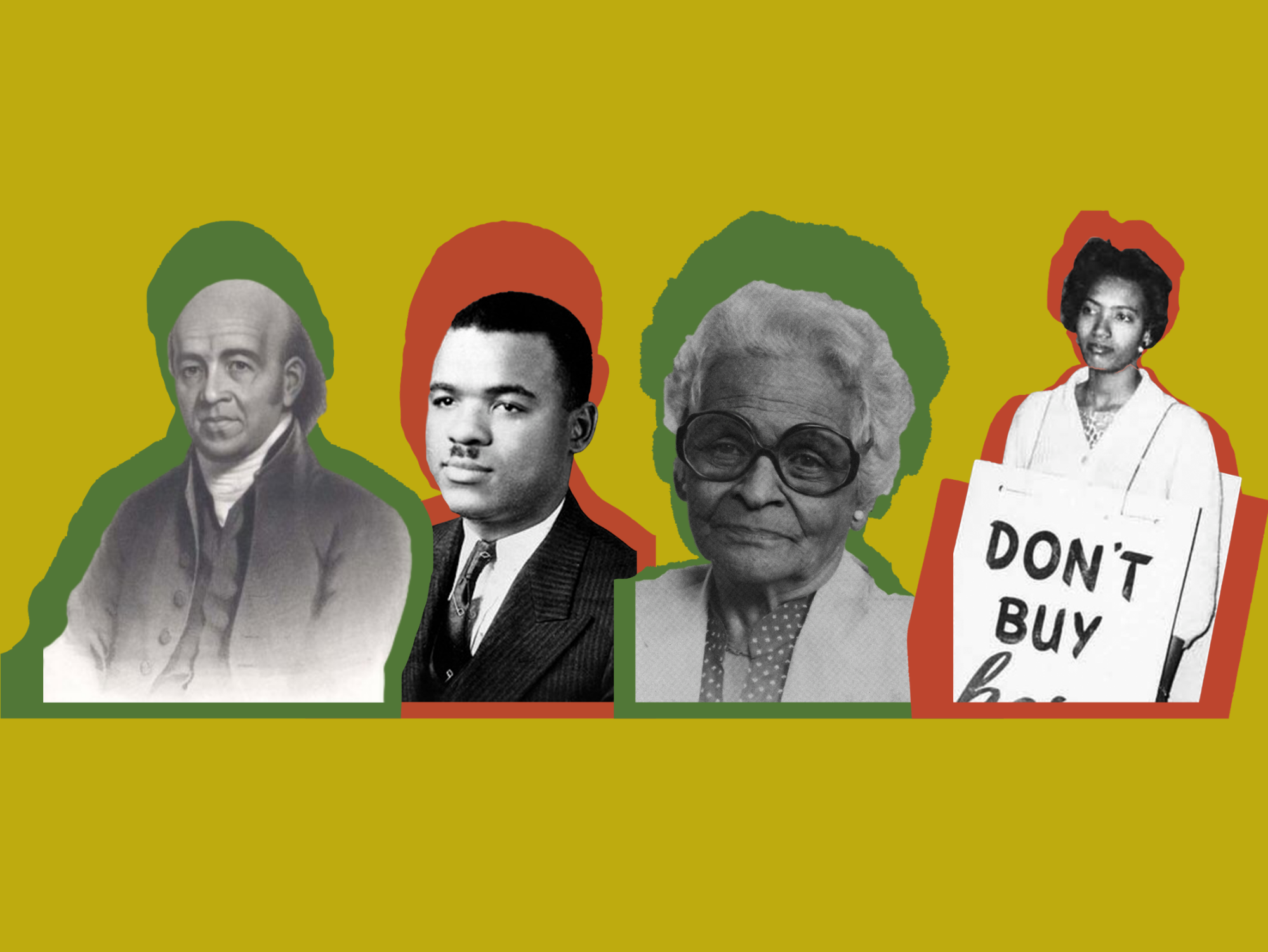
Grace Towns Hamilton was the first African American woman elected to the Georgia General Assembly. She was a lifetime advocate for the rights of the underprivileged and was involved in major district reapportionment initiatives and Black voter registration.
“She was very impactful with her work with the Atlanta Urban League,” Paul Crater, Vice President of Collections and Research at Atlanta History Center, said. “She was Executive Director there for almost two decades, and she and the organization had a great impact in terms of housing. There was a shortage of housing after World War II, especially for African-Americans, and her work with the Atlanta Urban League helped to open up areas, particularly on the west side of the city, for African-Americans.”
Hamilton highlights the Voter’s League’s guiding philosophy of preventive social work, aiming to address social issues reactively.
“We used the quote, ‘slogan’ of the agency that we were engaged in preventive social work,” Hamilton said in an interview archive, obtained from the Atlanta History Center, in 1985. “That is, we would try to work on the social situations which — preventive way as well as cure. We did organize a citizens’ committee for the improvement of public education, heading at a bond issue which had already been announced.”
As a result of their campaign, the Board of Education finalized its plans allocated for improvements to Black schools.
“The board of education announced that they had completed their plans for the bond issue,” Hamilton said. “They proposed a $9 million issue. I think $7 million of the $9 million was devoted to black school improvement.”
As the first woman to hold a job of her level at the Atlanta Urban League, Hamilton had to negotiate her right to an equal salary, something common for women who held jobs at the time.
“When she got hired in the Atlanta Urban League in 1941, she had to work within the organization to get her salary equal to the man who had previously held that position,” Crater said. “She was effective in straightening out that issue and had lots of charisma. She faced a lot of issues with the Atlanta Urban League improving healthcare for African Americans, but her role with the Atlanta Urban League was very effective in a number of different ways.”
Midtown Votes sponsor Claudia Black emphasized how Hamilton’s pioneering role as the first African American woman elected to the Georgia General Assembly offers insight into how inclusivity can inspire younger generations to pursue opportunities they might not have considered otherwise.
“I think when you see someone who looks like you, who has the same background as you, especially for younger people, it becomes ‘Oh, this is something I can do,’” Black said. “But when you only see a certain demographic, you think that job’s not for you.”
Black said it is necessary to apply a civil rights perspective to all initiatives, much like Hamilton did in 1964 as a co-founder of Partners for Progress, which led to the implementation of the Civil Rights Act.
“I think it’s extremely important, especially in the light of several laws now being repealed, that we in all our clubs, in everything that we look at it from a civil rights lens, even if it’s not a requirement,” Black said. “It’s important to make sure that you are getting the demographics of people because as much as you may hear about different demographics, you may not reach them.”
In 1952, Sellaway moved to Atlanta to live with her mother so it would be easier for her to get an education. Before that, Sellaway spent the first six years of her life in Round Oak, Georgia, living with her grandma.
“I went to school for the first day, and my grandmother said, ‘You’re not going to school anymore,’” Sellaway said. “The bus came by, but only the white kids rode on the bus. The black kids had to walk. My grandmother said seven miles, one way and back, was too far for me.”
Sellaway attended several elementary schools in Atlanta, including Our Lady of Lourdes Catholic School and Hope-Hill Elementary School. Sellaway graduated from David T. Howard High School (now David T. Howard Middle School), and she attended Spelman College, where she majored in home economics.
Throughout her childhood and most of her young adulthood, Sellaway experienced racism and discrimination.
“I went to Washington High to make up for a grade that I had missed, and I would get on the buses,” Sellaway said. “When you got on the bus as a black person, you were supposed to go to the back of the bus. If the bus had filled up and a white person got on the bus, the bus driver would tell the black people, ‘You got to get up and give them your seat.’ I can also remember going to the Fox Theater, and the blacks had to sit way upstairs, and the whites would sit downstairs.”
Sellaway said the discrimination she faced is what encouraged her to join the civil rights movement.
“I think it was because of what I experienced growing up, in terms of segregation and discrimination,” Sellaway said. “I had lived through those things and experienced them. That motivated me when Dr. King started his mission to be a part of it.”
Sellaway participated in countless protests, most of which were led by Dr. Martin Luther King Jr.
“Dr. King, as a person and as a leader, was amazing, phenomenal,” Sellaway said. “He was strong, he was outgoing. From the beginning, he was a man who surrendered his life for love, justice and change.”
When Sellaway was 21, she was arrested for the first time in a local restaurant in Atlanta while protesting. Sellaway went on to be arrested two more times.
“We were standing outside of the restaurant, and there were five of us out there,” Sellaway said. “Of course, the owner of the store says for us to move off of his property. We were instructed not to move. So they arrested us.”
Sellaway was then sent to a prison farm, where inmates were forced to do manual labor to sustain the prison. She recalled having to take turns with other students staying up at night, as they were fearful someone might attack them. Even in the prison, there was segregation.
“The main thing that stuck out at the prison farm was that the white women lived upstairs, and we lived downstairs as blacks,” Sellaway said. “At mealtimes, we as the blacks had to go into the kitchen and line up and get trays of the food for however number of white women that were upstairs. We had to walk up the stairs, one tray at a time, and serve them until we could serve ourselves.”
Sellaway remembers times when people responded violently to the protests.
“While we were down there protesting, there were persons of the white race who were against us being in there,” Sellaway said. “They would have fly spray, and they would spray us. Sometimes they will push us off the benches, and all those kinds of things. It’s something you’ll never forget.”
While many things have greatly changed in the U.S., Sellaway says racism is still ongoing, and there is still a lot of progress to be made.
“I think that persons who are not black and sense and see that there’s this discrimination, racism, they reach out,” Sellaway said. “Reach out to self and to others, to say, ‘We are all human. None of us gave ourselves life.’ Now, we should try our best to understand and love one another, and communicate with one another.”

William Alexander was a pioneering entrepreneur and journalist who revolutionized the Black press in America by founding the Atlanta Daily World, the first African American newspaper in the United States, in 1928.
Scott’s contributions served as the turning point for the region.
“I think with founding the Atlanta Daily World, which was such an influential newspaper, at such a young age, was where he put his imprint on journalism in the south,” Crater said. “To this day, I think the Atlanta Daily World is a well-known newspaper.”
Crater said that the Atlanta Daily World was a pivotal force for the black community at the time.
“It covered a lot of the issues relating to the black community that may have been covered in the Atlanta Journal-Constitution,” Crater said. “It may not have been covered in the same way, and with the same voices, but I think it was a valuable asset to Atlanta’s black community.”
Regarding African American newspapers as a whole, Midtown Advanced Placement Literature teacher Brian McNeil credits them for sharing the voices of the community in a sincere way.
“As a literary form, Black newspapers such as the Atlanta Daily World give our community an honest, trusted voice,” McNeil said. “In a time when mainstream media often misrepresented African Americans, these papers told our stories with truth and dignity. Many writers and reporters focused on covering news and stories that mattered to their communities, so readers knew they could trust the source and often saw themselves accurately reflected.”
Consequently, this commitment to positive representation and uncompromised reporting allowed the Atlanta Daily World to function as a vital tool for mobilization in the Jim Crow South.
“In terms of AP Lit themes, the Atlanta Daily World served as a ‘voice’ during segregation for individuals who were often ignored or had their stories distorted, representing themes of agency, perspective and self-definition,” McNeil said.
McNeil believes that the Daily World provided necessary dual-sided coverage to stories that impacted the community.
“The paper controlled the narrative by reporting life from within the community, and not through a filtered perspective,” McNeil said. “They would often cover and document injustices that would have been ignored by the major papers of the time, calling our discrimination and injustices. And by also affirming humanity by publishing stories of success, culture and everyday life that were positive and not about trauma or destructive topics that did little to move the community forward.”
Fairlie Mercer is a senior and this is her third year writing for The Southerner. She currently serves as an Editor-in-Chief and is excited for her second year as an editor. Outside of journalism, she enjoys hanging out with friends and dance.