Skip to Content
Categories:

The science behind the sound: how music builds connections

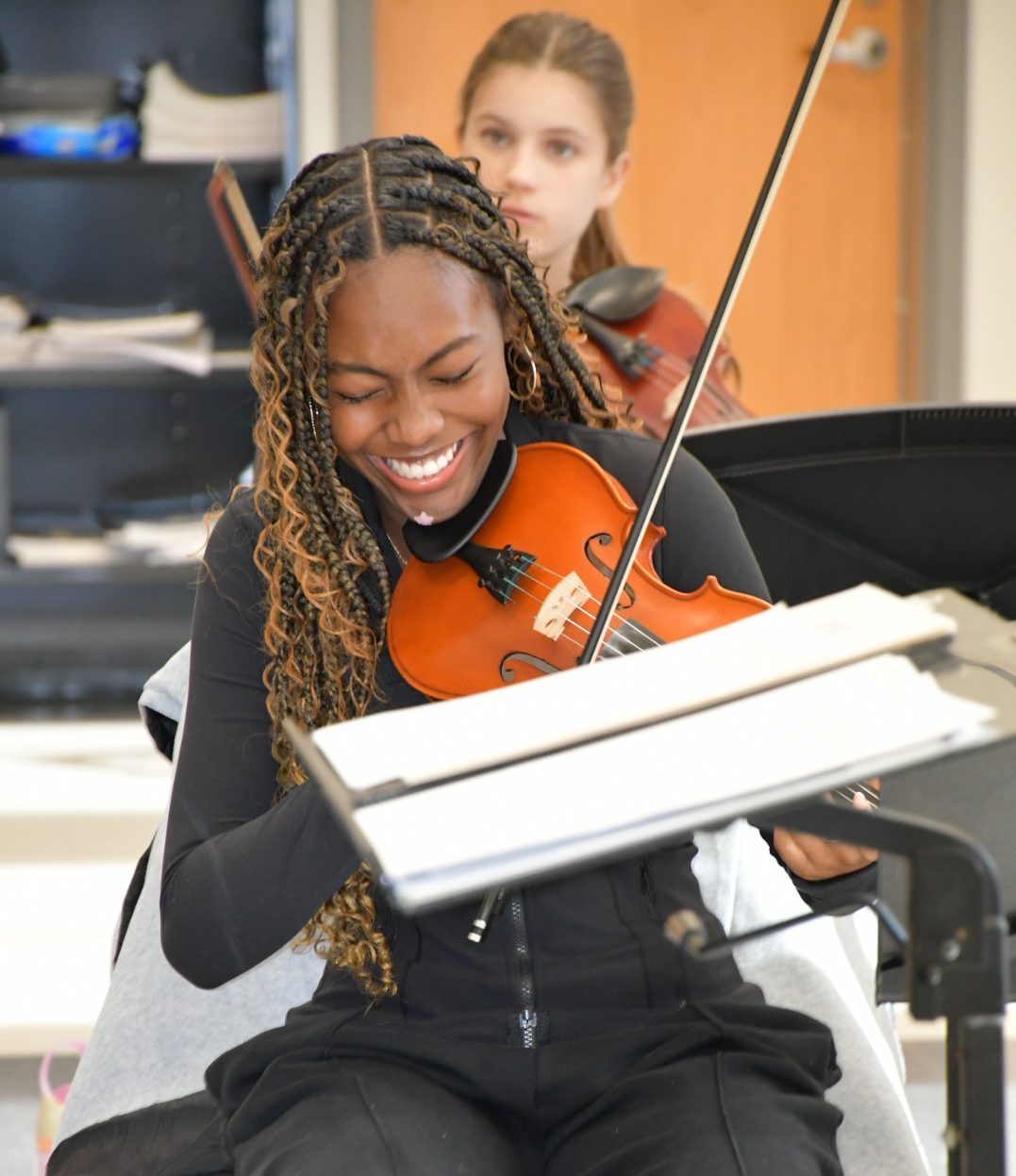
CLASSROOM CREATION: Freshman Sienna Miller practices the violin with her 3B Intermediate Orchestra class. Miller said she enjoys the class and practices violin at home too.
Audra Harrison

When music transforms sound, its impact spans beyond what is heard. It becomes art, self-expression, creativity and ultimately connection. Across the globe, music has played an indispensable role in preserving culture, religion, history and tradition. Before music was played on instruments, composed and broadcasted to an audience, it allowed for the development of social bonds and communication in prehistoric times.

According to University of Georgia Associate Professor of Music Education, Allison Farley, this trend persists today. 

“We are constantly mapping what we hear based on the experiences we’ve had previously,” Farley said. “[Music] is unifying in the fact that we can all sort of read each other and their behaviors off of it.”

Music’s impact is widespread and prevalent in many areas of life, Farley said.

“In all cultures, in all communities, humans are inherently musical,” Farley said. “We really pay attention to musical ideas, concepts and ways of thinking. This starts before we’re born because humans develop the ability to hear at about six months gestation, so they’re able to recognize speech patterns and tones of how your speech goes in your native language. Then eventually, after you’re born, those sounds are familiar to you.”

Psychological Intersection

Music psychology studies human interactions with music and the cognitive, social and emotional influences it creates. Farley said music psychology is interdisciplinary, meaning its fields overlap and work collaboratively.

“It’s really hard to parse out one way of thinking about music and psychology because there are acoustical things, which gets into more of concrete science, there are perception-oriented things, which deal with more anatomical and processing, and then we get into cognition, which is how you understand it and make sense of it,” Farley said. “Then we get into overlaying — those experiences that you’ve had as an individual and how you’re mapping those experiences on to what you’re hearing or interacting with.”

Chartered psychologist and Associate Fellow of the British Psychological Society, Dr. Claire Renfrew, explained that music often coincides with personal experience and emotion. According to Dr. Renfrew, music can be used clinically to help with emotional expression. In addition, it can be used to regulate emotions such as stress and anxiety.

“Psychology helps explain why [certain] effects occur, showing how music can influence brain activity, cognitive development and emotional processing in ways that promote health and well-being,” Dr. Renfrew said.

Music contributes to the release of hormones such as oxytocin, dopamine and endorphins. Dr. Renfrew said the release of hormones can cause music to have profound emotional impacts.

“Listening to a favorite song can trigger the release of dopamine, known as the ‘feel good’ transmitter, leading to feelings of pleasure and excitement,” Dr. Renfrew said. “Endorphins may be released during activities like dancing to music or singing, helping reduce stress, anxiety and physical tensions. Oxytocin, known as the love hormone, may be released when music is experienced in group settings, such as concerts or choirs, enhancing feelings of trust, bonding and emotional closeness.”

Farley found that music taste largely solidifies around the age of 24 while brain development finalizes around the age of 25. She highlights how these processes occur almost simultaneously.

“What you’re listening to when you’re about that age is what you’re going to listen to for the rest of your life,” Farley said. “Those are your highly formative years, socially, when you’re growing up and maturing and our frontal lobes are finalizing their final stages of growth. It’s funny how those two things line up. You can have many positive social experiences based on that time of your life being so formative.”

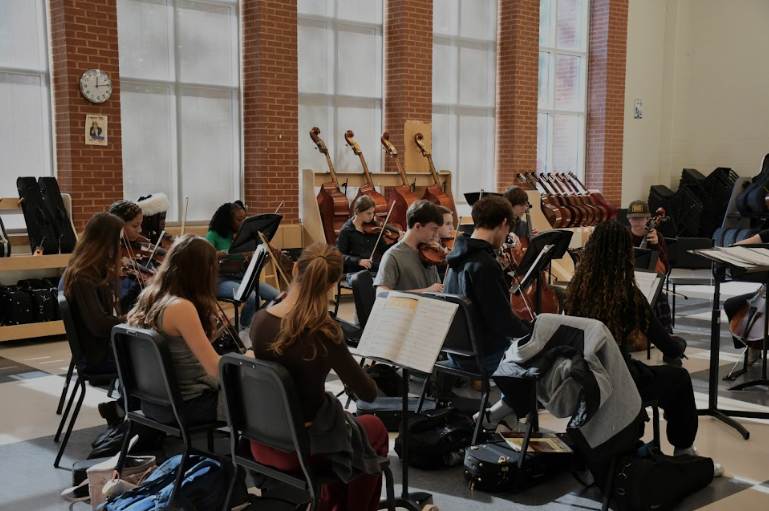
MUSIC ENVIRONMENT: The intermediate orchestra class practices sheet music. Dr. Renfrew said music in school can promote group connections and feelings of belonging.
Social Bonding

Farley found that school choirs, bands and orchestras can be highly beneficial for students mentally and socially.

“When it comes to public school music or concert going, you’re getting these extra musical things out of those experiences,” Farley said. “In school, you’re working toward a common goal. There might be some social interaction involved because you’re going on trips or you’re spending a lot of time together. It helps with personal accountability and responsibility and managing yourself within a larger organization in order to contribute.”

Midtown band director Carlton Williams believes social bonding is an essential part of music-making.

“Connections are very important,” Williams said. “Music is not a one person deal, you have a group of people, and you build those connections throughout the course of learning in that setting. It’s a very good social [experience] for high school students.”

Research suggests that music can play an important role in relationship building through common interests and experiences. According to Dr. Renfrew, shared musical activities can foster group connections and feelings of belonging.

“Schools often use music at events or through performances to build community and encourage collaboration between students and with the staff,” Dr. Renfrew said. “Community choirs, drum circles and open-mic nights are other examples of how music can bring diverse groups together, music being at the center of these shared experiences. Music has the power to shape emotions, strengthen social bonds and support mental well-being. Across different cultures and generations, music remains a universal tool for bringing people together.”

MUSIC ENVIRONMENT: The intermediate orchestra class practices sheet music. Dr. Renfrew said music in school can promote group connections and feelings of belonging.
Identity and Self-Expression

Farley believes the discussion of music and identity falls within two areas: “identity and music” and “music and identity.” Farley said both interpretations offer examples of how individuals connect with music.

“There are two different ways in which we can explore identity when it comes to music,” Farley said. “Does music influence you or are you drawn to music that possesses a particular thing that aligns with you?”

Dr. Renfrew said music can be crucial for self-discovery. 

“Music often plays a key role in self-expression, identity formation and development, especially during adolescence and young adulthood,” Dr. Renfrew said. “Musical identities are not linear and can be multiple. That’s the fun of music, it allows you to experiment and explore different parts of your identity.”

Williams said the diversity of music allows listeners to resonate with artists, songs and performances.

“I think that to say you don’t like music is like saying you don’t like to eat,” Williams said. “There is some commonality in it. Of course we all have different preferences in music, but in some shape, form or fashion we all can find some connection with music.”

In addition, Williams believes music can allow people to process difficult emotions.

“I think that music is an outlet for expression,” Williams said. “If you don’t have another way of communicating yourself, music will be a great catalyst for that. I know that for me if I’m upset, if I play something really fast or loud, it’s a way or form of expression. If I am in a mellow mood, I might play a beat that is modeled on the way I’m feeling.”

Farley said music is subjective, believing it can be interpreted to have numerous insights and takeaways. 

“[Music] is uniquely personal,” Farley said. “If you’re creating music, you might have a certain intent, like an emotional intent, but somebody listening might not recognize what that is. They’re mapping their own experiences on it and interpreting the emotional message, but it might not be the same as what you intended, so there’s a lot of gray area in there too.”

According to Dr. Renfrew, music can be a tool to transcend boundaries, often symbolizing deeper messages or experiences.

“Music is powerful and can encourage empathy by allowing listeners to emotionally connect with stories and perspectives beyond their own,” Dr. Renfrew said. “Songs that address themes such as mental health, social injustice or personal struggle can help listeners understand experiences they may not have lived themselves. Songs are stories and an opportunity for songwriters to express their past lived experiences and narratives. When people share music, it often leads to deeper conversations and emotional connections, strengthening interpersonal empathy and bonding.”

More to Discover
About the Contributors

Dylan Seinberg
Dylan Seinberg, Lifestyle Associate Managing Editor
Dylan Seinberg is a junior and this is her second year on the Southerner staff. When she is not writing, you can find her hanging out with friends or running. She is a co-president of Education Advocacy Club, project forums manager of 21 Club, and outreach coordinator of Impact Teen Drivers. She is excited to be on staff this year.
Audra Harrison
Audra Harrison, Photographer
Audra is a sophomore and this is her first year taking photos for the Southerner. Outside of school, she enjoys swimming and hanging out with friends.