Junior Mai Ishihara, a Japanese-Chinese exchange student, worked as a professional model in Nagoya, Japan for three years before coming to Midtown to improve her English. She has been staying with her host mother since late August and will return to Japan in May.
Before moving to Japan with her father, Ishihara lived in China for seven years. Ishihara said she has used her modeling money to visit her mother, who still lives in China. Due to her time spent in both countries, Ishihara speaks both Chinese and Japanese, but she has different relationships with the two languages.
“If [I] have an argument, I really want to use Chinese, because Chinese sounds more like an attack,” Ishihara said. “I think my Japanese is better than [my] Chinese, but sometimes when I want to speak Japanese, I forget how to [say] something, but I know what it’s called in Chinese.”
Ishihara’s friend, junior Wen Pan, moved from China to Atlanta in his freshman year and enjoys having someone he can relate to about his past.
“I don’t really mind [which] language [we use], but speaking Chinese to other people in school sometimes makes me feel like [I’m] having encrypted communication because nobody else will be able to understand,” Pan said.
Ishihara believes high schools in Japan and the U.S. differ in a lot of ways. She said in Japan, students must take an entrance exam for high school. Additionally, school lunches are of a higher quality, so less food is wasted. However, what shocked her the most at school in the U.S. was the behavior of her peers.
“[While] the teacher was teaching us some things, the students were talking,” Ishihara said. “They were eating [their] snacks. They were chewing their gum. I can’t imagine. The first day when I came to this school, I was so surprised because I can’t believe the students are not respectful to the teacher.”
Ishihara also believes the classes are less academically rigorous than in Japan, but the language barrier has made it more difficult.
“It’s really hard for me because, in all the classes, the teachers are using English; they all speak English,” Ishihara said. “I know I’m studying English, but if you hear the real, native English, you’re going to be so confused. It’s too fast, and people like to use slang. A really big problem for me is the slang, and they like to connect words.”
When she first came to Midtown, Ishihara resorted to using translation apps for her classes such as U.S. History, but she believes her English has improved dramatically since she came to Midtown.
“My English skills still sound like a rollercoaster,” Ishihara said. “Today my English is not good, but tomorrow it’s going to be really good, then not good, then really good … I can feel my English skills improving, and I had my first English dreams two weeks ago. I was so happy.”
Ishihara hopes to use her English and Chinese to become a flight attendant as an adult, but in the meantime, she has found her language skills useful in her modeling career.
“[For auditions], you have to introduce yourself,” Ishihara said. “I [would say], ‘I can speak Chinese, Japanese and English,’ so if there’s some work in a different country, I can use my language skills to do well.”
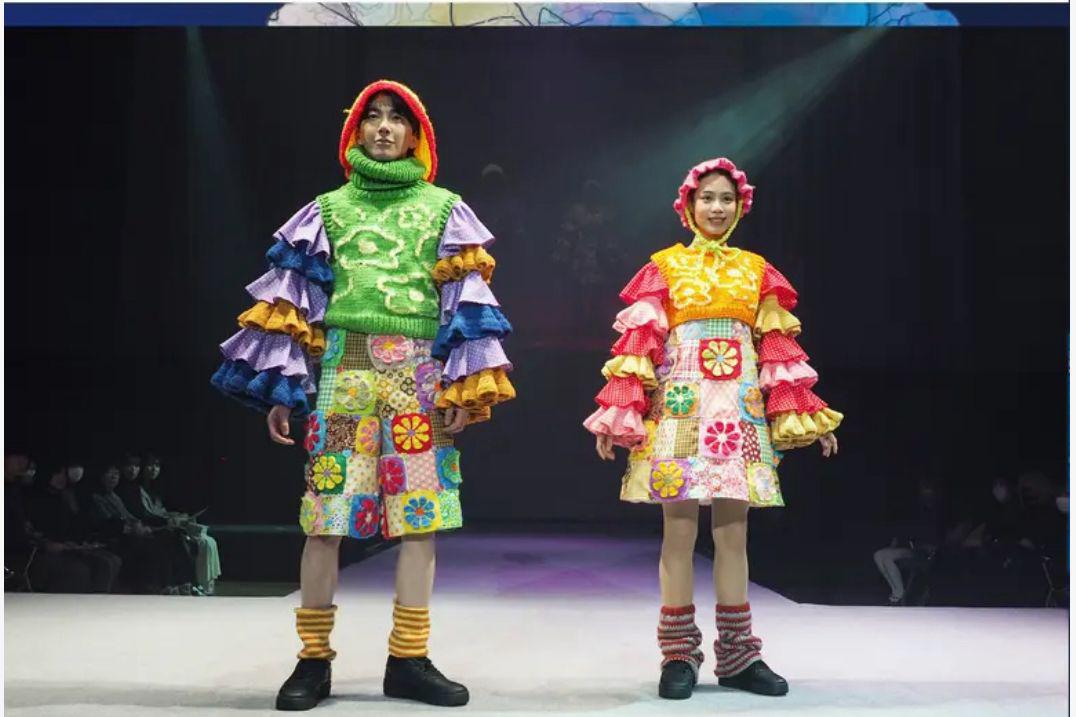
Ishihara first became interested in modeling after her friend suggested she audition because she was taller than most women in Japan. She recounts how modeling companies would take measurements including weight, height, skin condition and even finger size. She said her past modeling experiences have shown that a large part of modeling is being proactive and open to opportunities.
“The most important thing is you have to act,” Ishihara said. “You have to move, you have to do some action. You have to research, [and] you have to apply for the audition. It’s all about you. You can’t just say, ‘I want to be a model. I’m so pretty, and I want to be a model.’ You have to actually do something.”
Sophomore Amelia De Sutter and Ishihara first connected over their shared Japanese heritage and have since become good friends. De Sutter will be modeling for Midtown’s fashion show this spring and said she appreciates the modeling advice Ishihara has given her.
“She’s taught me that there’s a lot going on behind the scenes, and that one minute of a fashion [show] is an accumulation of a lot of things behind me, like photographers and how to show your clothes that you’re wearing in a way that does justice to them,” De Sutter said.
Ishihara has participated in fashion shows and acted in commercials for a variety of brands, including those specializing in sportswear, school uniforms and summer clothing. She believes it is important to be flexible and open-minded when working as a model.
“One [hard] thing is during the winter, in modeling life, if the companies want to sell the summer clothes, you have to take the picture or pamphlet in winter,” Ishihara said. “You have to wear a tank top outside, and it is super cold. But you still have to be laughing, you still have to smile. It’s like, ‘Oh, I’m so happy, it’s summer,’ but it’s not. It’s super, super cold. And it takes a long time. Four clothes [are] going to take one hour. There are different positions, and they have to fix your hair [and] fix your makeup.”
Despite the occasional drawback, Ishihara has loved the experiences modeling has given her. Her work has led her to travel for free to new cities, such as Osaka, and meet new people.
“You can learn from people how they’re using skincare [products] for beauty, and how to cook food,” Ishihara said. “It’s really helpful, and modeling is for every age. Most of the people that I meet are older than 20 years old. You can make a lot of modeling friends from there, and you can get a different experience. It’s really exciting.”
Ishihara also believes modeling has helped her expand her personal style.
“If you’ve been in modeling, you have to pay attention to the fashion styles more than before,” Ishihara said. “You have to know what suits you. You can challenge any new fashions even if it’s not good for you, but people will think, ‘Oh, that suits her because she’s a model.’ That helps me a lot.”
De Sutter values the opportunity to practice Japanese and said speaking to Ishihara allows her to use informal language and be exposed to more teenage and regional slang. She said she admires Ishihara for her ability to balance modeling with academics and participate in an exchange program.
“I admire her perseverance and the strength that it takes to move across the world, live and go to school, [all] while using a completely different language,” De Sutter said.
Ishihara has mixed feelings about returning to Japan, where she plans to continue to model professionally until she graduates from college.
“It’s sad, but it’s also exciting, because I can see my friends in Japan,” Ishihara said. “I can see my family. I can eat Japanese food — the real Japanese food. But I [have] a lot of friends here too. But I was thinking: I’m not dying. Nobody is going to die, so we can still [talk to] each other.”