Largest ‘No Kings’ protest nationwide takes place March 28, protestors fight against ICE, Iranian war


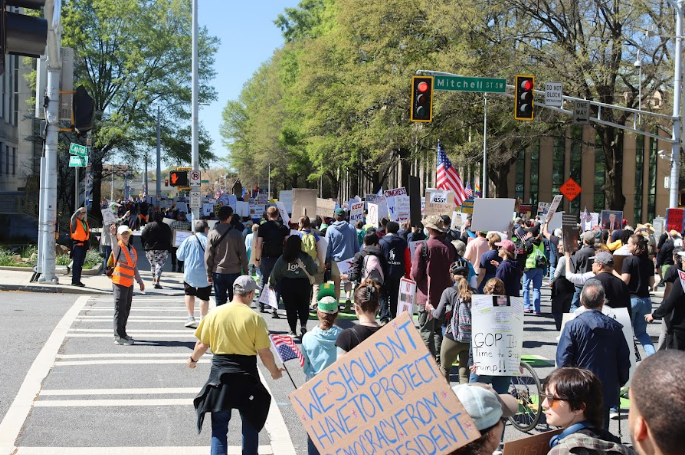
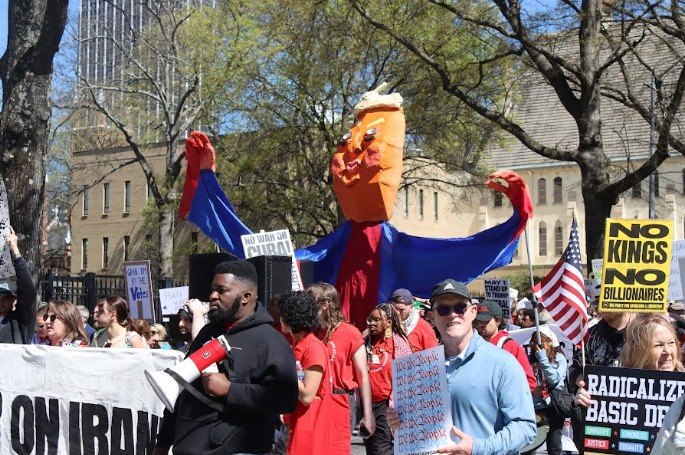
An estimated over 8 million people joined together for the third and largest ‘No Kings’ protest nationwide. The assembly took place on March 28, 2026. The strand of protests originated in June 2025 as a nonviolent movement, stemming from the 50501 Movement and several other liberal activism groups to oppose the deemed authoritarian action and policies of the Trump administration. This event specifically, was centered around the Iranian war and Immigration and Customs Enforcement taking their stake in Georgia.
Protest participant Max Bricks* noted his concern of the current government turning into a dictatorship and the current political leaders taking full control of US citizens’ lives as motivating him to join the protest.
“[I came to protest] because we are very unhappy about all the policies and actions of the Trump administration,” Bricks said. “I think they’re destroying the country [and] they’re destroying democracy in our country. Basically converting us to authoritarian countries like Russia, so this is horrible. We want to change that.”
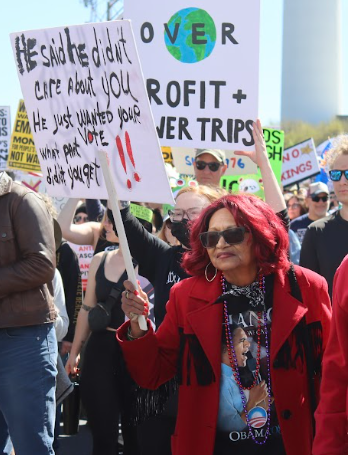
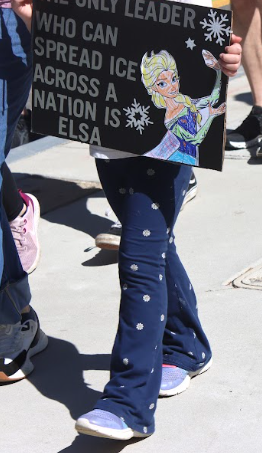
In all of the No Kings protests so far, participants carry posters along their march, depicting a range of criticisms against the government. Marissa Hudson*, a volunteer helping facilitate the protest, said these protests allow for certain issues to be highlighted, and show what things are concerning to the general public.
“I think that seeing the people around you and what they have to say, what posters have to say, people become aware of issues they may not have been thinking about,” Hudson said. “The [posters] have conversations with people, and they acknowledge that they’re not alone and in their concerns. I think protests are one way [to make change].”
Marshall May Tea has been working to keep Atlanta’s protests safe since the Hands Off march on April 5, 2025. She said protesting helps her feel more connected to the Atlanta community.
“It’s so exciting to see other people feeling the same way, especially in a city like Atlanta, where everyone’s in their cars at the time, so it’s hard to know how people feel about things,” Tea said. “It is good to be in person somewhere with people that feel the same way.”
The protest organizers handed out water, provided bathrooms and staffed the event full of marshalls in orange vests who focused on crowd control and safety.
“I’m a Marshall, and so right now, I’m keeping an eye out and just keeping everybody safe and making sure the event stays safe,” Tea said. “We’re here to protect us.”
The Party for Socialism and Liberation helped to organize parts of the protest. For this protest, the party’s main focus was against ICE and the war in Iran. Miles Weatherington, a party member and community organizer who attended the event, highlighted the party’s purpose of attending the protest as to unite the working-class and fight against the actions of the Trump administration.
“I’m a member of the Party for Socialism and Liberation and I am a community organizer,” Weatherington said. “We’re actually here with the anti-work coalition. We came here, along with other people, millions of people across the United States, to reject the war on the working class here at home and the war on the Iranian people abroad. We’re here to kind of organize working-class people and build the movement that we need to just fight back against the billionaire agenda, which is forever worse.”
Hudson highlighted her connection with the effects of the current US administration motivating her to want to join the protests.
“I work with immigrants of all types,” Hudson said. “I have a spouse, who’s an immigrant, and I think the current administration is attacking immigrants because it’s easy, and it’s a populist movement, and is a way to get people, but hate doesn’t win, love wins. It’s a horrible reality that there are people sitting in detention centers doing nothing other than trying to make their lives better.”
Adding onto this, Bricks argued that no specific groups of people are affected by the Trump administration, but all citizens are. Gas prices, living prices, inflation, any negative effects of the administration can affect anyone, according to him.
“Everybody is directly impacted [by the Trump administration],” Bricks said. “Everything from people’s rights, from transgender laws, we have people in the family who are transgender, and they cannot go into a bathroom now.?But also, prices of gasoline, prices of everything. The stock market is down, like the cost of living is up. But this is just the economic side.”
ICE is currently building a new detention “mega center” in Social Circle, under an hour from Midtown. The center is projected to be done by the end of FY 26 and will house between 7,500 and 10,000 detainees.
“The threat of ICE coming to Atlanta is the most worrisome thing right now,” Wallace said. “I’m a white male, who’s a citizen, not directly being targeted. But it still very much affects the people I love in my community.”
Smith worries that Trump’s presidency may inspire future presidents to push the boundaries of their power. In Trump v. United States (July 2024), the Supreme Court found that former presidents have absolute immunity from criminal prosecution for official actions conducted while in office, something former President Biden described as a “dangerous precedent.”
“I hope whoever gets in office next– whether it’s Democrat, Republican, or a goose or a geese– I hope they don’t think, ‘Well, President Trump got away with it, so I’m gonna try it too,’” Smith said. “That’s my main scare, that whoever gets in office now, they feel like they can get away with it too. We gotta be careful, because the can of worms has opened up.”
Weatherington explained his motivation for his involvement in the protest as seeing the direct effects to him, and those around him the US government has had. He said he is working to fight for the working people, and both the Party of Socialism and Liberation and the protest, has enabled him to do so.
“What motivated me to get involved was seeing the way in which the government that speaks in my name, has just terrorized the global soil,” Weatherington said. “For as long as we can remember, the US has played an imperialist role and has subjugated people of the global south to domination. Seeing that firsthand, having friends from the global south, it started to make the connections that it wasn’t just a policy choice, it’s actually embedded in the system that we live in.”
Weatherington explained that this sentiment gave him realizations about who the government truly represents.
“It really started to transform me, and I started to realize that both of these parties don’t represent working class people here at home,” Weatherington said. “They represent the billionaires. I wanted to get organized with a party that was gonna fight for working class people.”
While economic effects from the government are prevalent, Bricks said, the political effects are more of an issue. Max cites historical government systems such as the Soviet Union and warns against the US following the same path, institutionally.
“The political side is much more concerning because we grew up through the Soviet Union,” Bricks said. “We saw what the South Mediterranean system looks like. Now, America is turning basically into Sovietian into Russia. It’s all the censorship, the cult of personality, that’s what it is here. Like, we’ve seen culture personalities for Stalin, for Mao Zedong in China. Now we have a cultural personality for Trump.”
Protester Linda Smith said protests are empowering, especially during a time when politics can feel sad or out of control.
“You just can’t take it anymore, so either you stay home and ball up in a knot, and get depressed, or you come out and you cry, but you still come out,” Smith said. “You come out to curse, but you still come out, because something needs to be done.
Weatherington believes protests hold great power in terms of changes made. It is an opportunity for any person to be politically active, he said.
“Where the real power comes from, with protests like No Kings, is that, for many people, it’s the first time that they’re actually, politically in motion, that they’re politically activated,” Weatherington said.?”For us, it’s not enough just to come to a single protest and call it a day, like you did your civil duty. We actually have to get organized. We have to build up organization within the working class.”
Weatherington believes protests are a stepping stone for political motion, allowing people to enact further engagement into other situations outside an organized protest.
“This is the next step for people to get engaged politically, to get organized in their communities, at their workspaces, with political organizations like the Party for Socialists and Liberation, and building up to Mayday,” Weatherington said. “Because Mayday, unions, community organizations are calling for a general strike. Meaning no work, no school, no business as usual, across the United States, because that’s actually what it will take to defeat Trump, these racist agenda at home, and the imperialist and general run.”
Hudson said there are more ways to advocate for change other than protests.
“There’s lots of ways to be a part of not being silent about concerns,” Hudson said. “It doesn’t have to be a protest. It could be helping others get to the polls. It could be helping individuals get food or supplies that they need because they’re impacted by the federal cuts.?It could be lots of different things.”
Protester Jackson Wallace said protesting helps him build community, something he feels is lacking from other parts of his life.
“I’ve been surprisingly isolated, and I’m looking at joining more communities,” Wallace said. “It’s also why I come out here. When you ask me about the community, it’s like, ‘Gosh, I know my friends, but I don’t actually know my neighbors [and] what they think.’ And that seems messed up to me. I feel like I’ve been a little disempowered by the lack of community relationships that I have.”
Similarly, Bricks noted the lack of direct effect a protest may have on the government, but instead how it can mobilize the people to advocate for change of their own. To him, this can range from voting, and creating unity amongst like-minded people to advocate for their beliefs.
“Obviously, the Trump administration ignores everything, so I don’t think they will change, but it is for other people to show how many people are unhappy and against this communicatorship,” Bricks said.?”I think it is for us to kind of align and join forces. And frankly, we have an opportunity for the election in the fall. We hope that more people will come to the election to unseat Trump and MAGA.”