
Nutrition oasis: Azalea Fresh Market combats downtown food desert


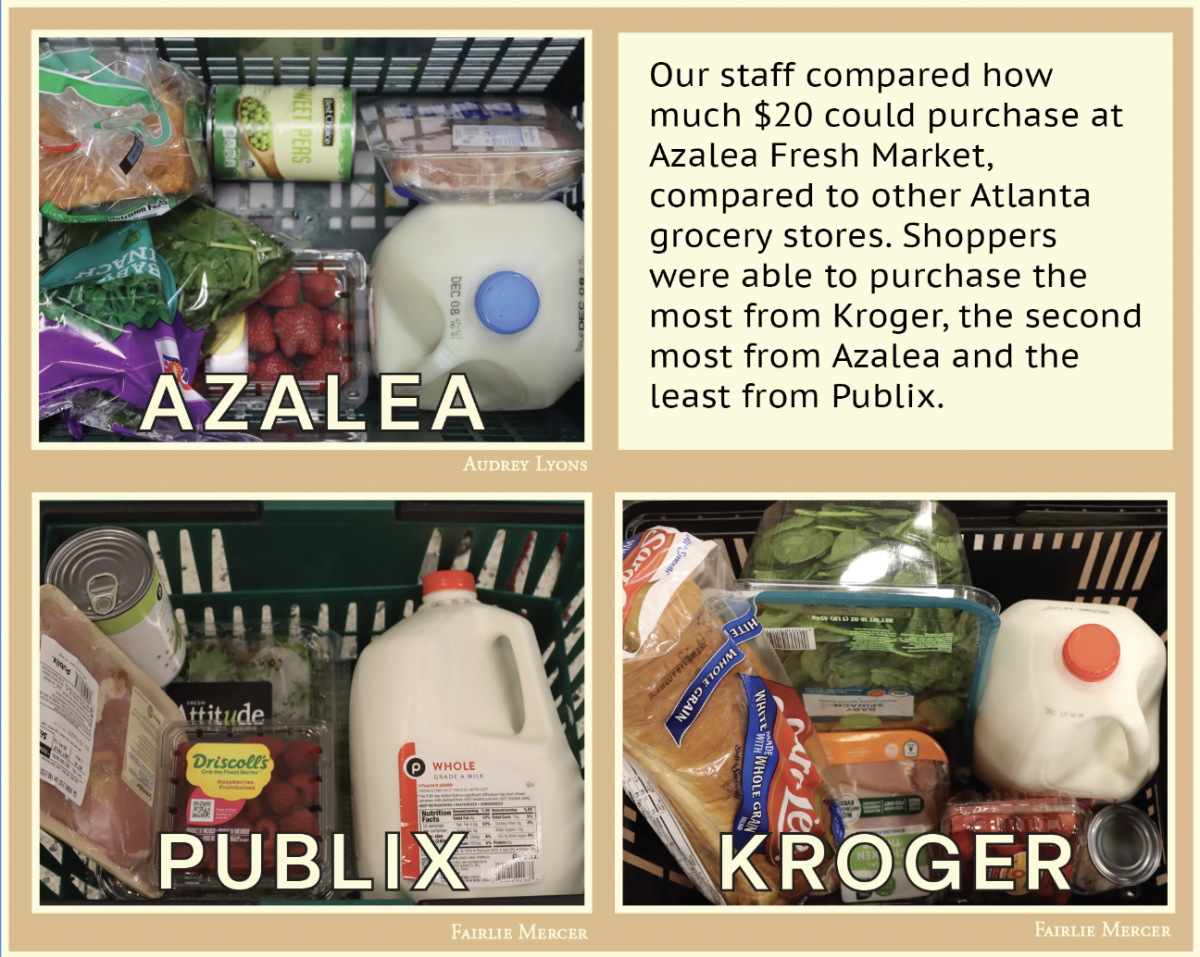
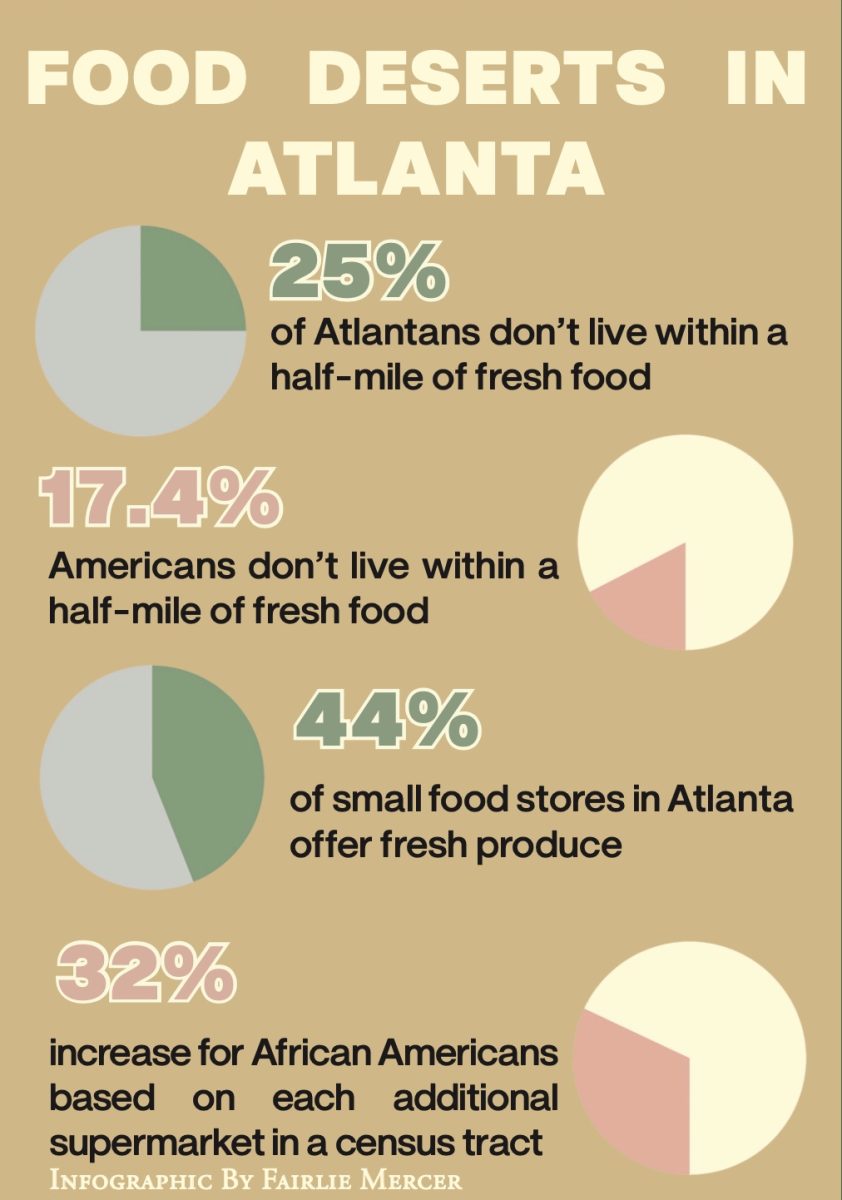
One quarter of Atlantans don’t live within a half-mile of fresh food, according to the City of Atlanta’s 2020 Fresh Food Access Report. Atlanta aims to combat this issue of food deserts with its opening of Azalea Fresh Market, Atlanta’s first city-sponsored grocery store. Food deserts, such as the one in downtown Atlanta, are areas without grocery stores that provide affordable, nutritious food and are often found in low-income or minority neighborhoods.
Downtown Atlanta, made up of towering hotels, convenience stores and Georgia State University’s campus, didn’t have a grocery store until Azalea Fresh Market opened on Sept. 8. The store was established by Invest Atlanta, the city’s economic agency, the Independent Grocers Alliance (IGA) and Savi Provisions, a local market chain. This public-private partnership plans to open another grocery store in Campbellton Plaza in Southwest Atlanta in late March to combat food deserts. Invest Atlanta CEO Dr. Eloisa Klementich explained how the Campbellton Plaza store will resemble the model of Azalea Fresh Market.
“We have created great relationships with Georgia Grown, and we’re gonna implement the same thing at Campbellton,” Dr. Klementich said. “There is a whole section for local startup entrepreneurs, so we’re going to have local products. [Also, both stores] have a relationship with Dope Coffee, which is a local minority business entrepreneur.”
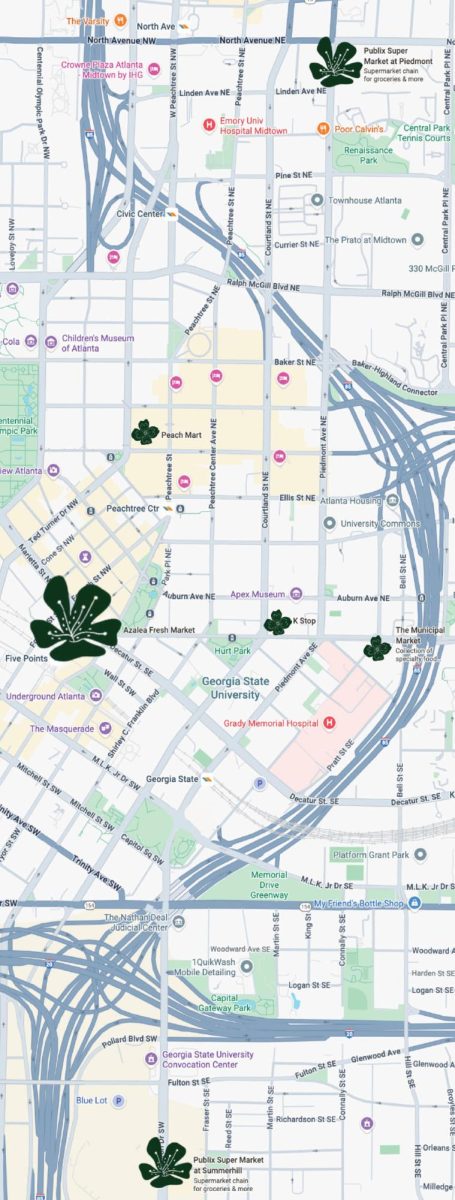
As the store is on the Georgia State campus, it mainly serves the university’s students, according to Jayda Powell, Azalea Fresh Market’s general manager. While Georgia State students benefit from this access to fresh produce, Rodney Lyn, Georgia State’s public health school dean and a food desert expert, believes Azalea Fresh Market wasn’t optimally placed to help meet the needs of those most affected by food deserts.
“Until you get market-rate housing and a community that people want to live in, I’m not sure [if] downtown, right [near] Georgia State is the place where you’re going to see people suffering,” Lyn said. “I think it’s more [in areas such as] Southwest Atlanta where it’s low income, and people don’t have the options around [transportation].”
Lyn describes how Azalea Fresh Market is multiple blocks away from downtown’s residential areas, so he doesn’t believe it will get the clientele needed for it to serve its purpose.
“I would be ecstatic if it was successful,” Lyn said. “It’s taken a lot of money from the city and other investors to start it up and to offset the startup costs. But I think it’s gonna need some time to see housing density increase.”
Despite this, Powell believes Azalea Fresh Market has been successful in giving the community access to fresher food than what was available before downtown had a full-fledged grocery store. Additionally, Powell was surprised by the preference of university students and other customers toward the fruits and vegetables offered at the store.
“The most positive reviews I hear [are] ‘We needed this’ and ‘There was nothing else around here,’” Powell said. “I think part of the reason why we don’t sell as much junk food as we anticipated is because people used to just buy their groceries from CVS, when really their only selection [was] fast food – quick little meals, candy bars and stuff like that. The fact that we offer a wider variety of the healthier options that you would primarily look at in a grocery store [is] what puts us over the top.”
Midtown social worker Nakisha Scott said impoverished areas often have limited access to fresh groceries. In its first month, fresh produce made up 11.6% of Azalea Fresh Market’s total sales, which exceeded the national average of 10%, according to a CBS article.
“In many impoverished areas, you see a lot of liquor stores,” Scott said. “You see churches. You don’t see a lot of healthy corner stores, municipal markets [or] fresh markets. You might see a place that serves unhealthy food, like fast food, food on the go, or even the local gas station might sell a burrito that you warm up, and we know that’s not the healthiest of food.”
With Azalea as an alternative to convenience and liquor stores, Scott believes that it will not only expand access but also increase knowledge for people in the community on the benefits of fresh food.
“I think that it would give more people an opportunity, one to be educated on healthy food,” Scott said. “Because I would hope that they provide a level of education for people on why this is the better way, as opposed to getting processed food versus fresh vegetables and lean meats and things like that. So, I would think that having the opportunity to be able to shop in those places and learn a different lifestyle would be beneficial.”
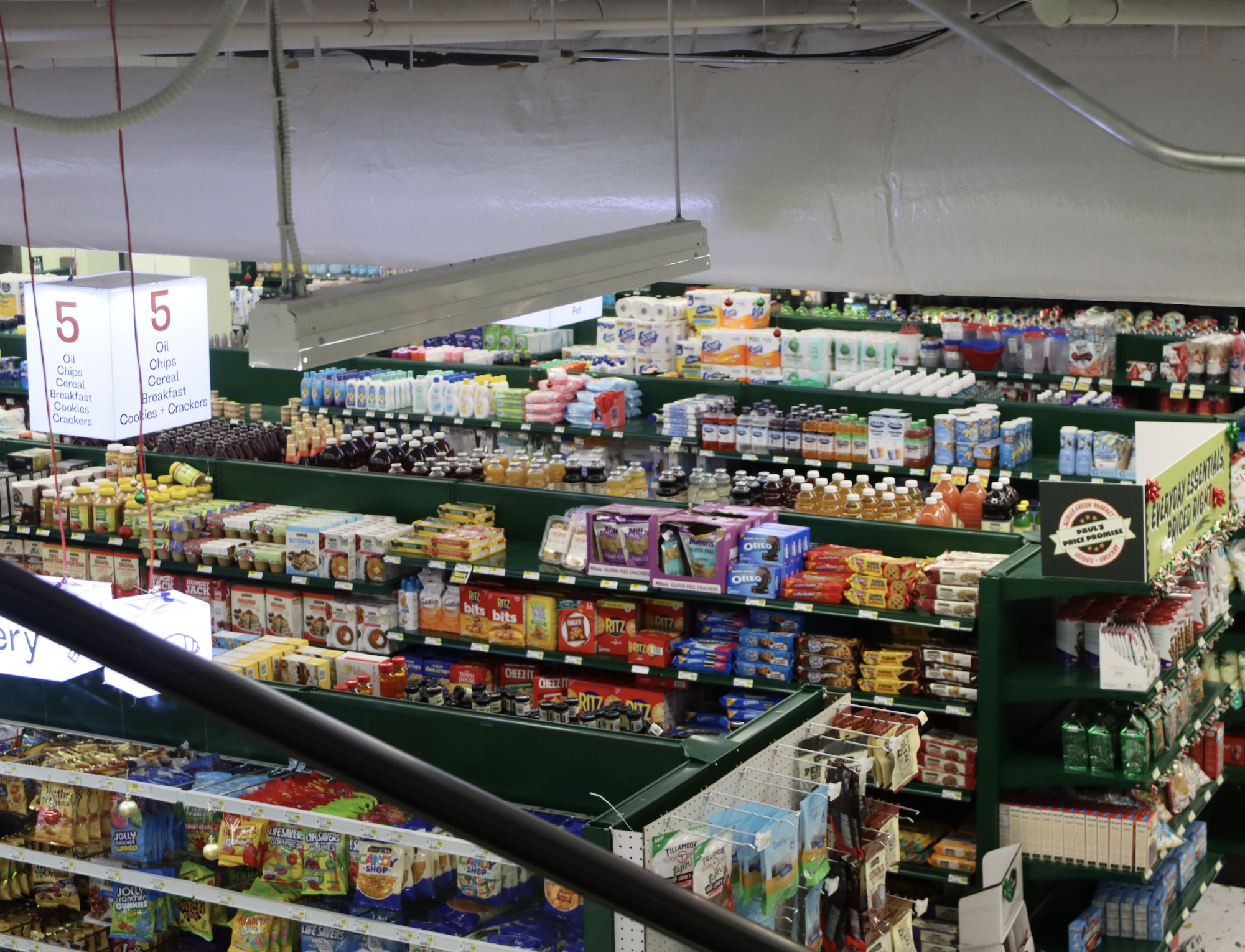
Powell said Azalea Fresh Market has been successful so far, as it made 50% more in the second month of opening than it did in the first. She believes this signals the store will be self-sustaining going forward.
“I think it’ll be fully independent,” Powell said. “The city was instrumental in helping us bring it together, but I think in the future, we’ll be able to sustain ourselves.”
Due to the market’s unique public-private partnership, the store is run independently from other stores owned by Savi Provisions.
“It’s been different because this is a startup,” Powell said. “I’ve done just about everything from scratch when it comes to making a management system [for] employees [or] making procedures for everybody. All things operational come from me, and it works for them. Compared to when you go to big box retail stores, everything is already set for you, so I’m following their system. Here, I had to create my [own].”
Azalea Fresh Market customer Dr. Kay Smith said the grocery store has made it possible for him to shop in-person instead of online. Additionally, he welcomes Azalea Fresh Market’s built-in restaurant.
“I love the idea of the restaurant upstairs,” Dr. Smith said. “That’s fantastic for when I don’t want to cook, or I need to grab something fast.”
Dr. Klementich believes Azalea Fresh Market has been a great initiative, and she plans to continue working to combat food deserts.
“We want to continue to attract new stores and whether they’re our [city-sponsored] store or [not],” Dr. Klementich said. “We have great relationships with all these other big chains that you’ve seen around you, because we’re gonna need it all. To address food deserts, we need everybody to lean in, not just the municipal markets. We can’t take care of it ourselves only. [Also,] we want to help the infrastructure that’s already there. In Atlanta, what’s amazing is there are a lot of little stores out there. We’ve been very strategic about how we can lower costs in those markets to give people access.”
This year, an estimated 53.6 million people nationwide live in a low-income and low-access (LILA) census tract. A LILA tract, more commonly known as a food desert, is any census tract where a significant portion of the population lives more than a half-mile away in an urban area or 10 miles away in a rural area from a supermarket.
Angela Zhang, a public health program associate at Emory University who has previously worked on projects quantifying food deserts, believes one common misconception about food deserts is that they can only occur in rural areas.
“It can be in a rural area, but it can also happen when there’s a ton of people,” Zhang said. “It can be located somewhere that’s seemingly well-populated. But if you drive around, you just see it’s block after block [of] all these corner stores. There’s a little corner store at each intersection of the blocks. [However], there’s nowhere to find a grocery store to purchase regular healthy food.”
Two major drivers of food deserts are a lack of transportation and a lack of nearby supermarkets, both furthered by economic and racial inequality. A study conducted by Emory researchers found food deserts disproportionately impact Black and low-income communities. Many lower income families can’t afford to regularly travel to areas with full grocery stores and those grocery stores aren’t in their area because it’s not as profitable for businesses.
“These [low-income and low resource] areas don’t attract business, especially [those] that are targeted at higher income [or] middle class [people] that can afford these more expensive fresh produce,” Zhang said. “A lot of these healthier options are more expensive. They have higher purchasing powers. [Higher income neighborhoods] can afford these options, so they don’t really attract these [smaller convenience stores].”
For Midtown students struggling with food insecurity, Scott said that Principal Dr. Betsy Bockman is well aware of individual student needs.
“Dr. Bockman is very in tune with what’s going on, and she also assists with ensuring that our families are able to be supported in that way,” Scott said.
The business models of many stores in food deserts are simply not set up for stocking fresh produce. Fruits and vegetables cost more, have a shorter shelf life and require expensive refrigeration equipment, in addition to challenges surrounding logistics.
“[Providing healthier food] requires a lot of infrastructural and technical support to the stores because thinking about stocking this produce, you not only need the supply chain, [but] you need vendors, and you need the suppliers to supply this produce,” Zhang said. “You need somebody to transport them, ship them to the store. You also need the equipment to store them to display them. [Convenience] stores normally don’t have these.”
The economics of many low-income neighborhoods perpetuate the lack of nutrition-focused supermarkets or restaurants, causing a need for government-subsidized businesses, such as Azalea Fresh Market, to open up.
“If your neighborhood is filled with all these unhealthy food options, it might be harder for businesses that are catering to health-conscious consumers to thrive or to even start, just from a competition’s [standpoint],” Zhang said. “If most of your customer base is used to this one type of product, it might be hard to sell a different type of product.”
The lack of nutrition faced by residents in food deserts can cause a variety of health issues. Residence in a LILA tract is correlated with child obesity, according to one 2024 study published in JAMA Pediatrics, and increased severity for cardiovascular issues, as stated by a 2019 study published in JAHA. Lyn believes food deserts exacerbate health inequality, as they affect minority and low-income communities at the highest rates.
“Heart disease and cancer are the top two leading causes of death, and they’re both tied to what we eat, at least, in part,” Lyn said. “Diabetes is also a major chronic disease driven by what people eat. If we’re gonna get our arms around those things, we have to figure out how to support those that are eating the least well. Those tend to be people who have limited means or [limited] access to healthy food. I think [Azalea Fresh Market is] a good project that the city is undergoing here.”












Fairlie Mercer is a senior and this is her third year writing for The Southerner. She currently serves as an Editor-in-Chief and is excited for her second year as an editor. Outside of journalism, she enjoys hanging out with friends and dance.