It’s alive! – again. Oscar winner Guillermo del Toro’s “Frankenstein” is the latest adaptation of Mary Shelley’s 1818 novel, a book he considers to be his bible.
Del Toro first saw the 1931 film as a child in Mexico. He described the feeling in an interview with NPR as being “struck by a lightning bolt of fever.” Ninety four years after that film’s release and 207 after the book’s, “Frankenstein” fever persists.
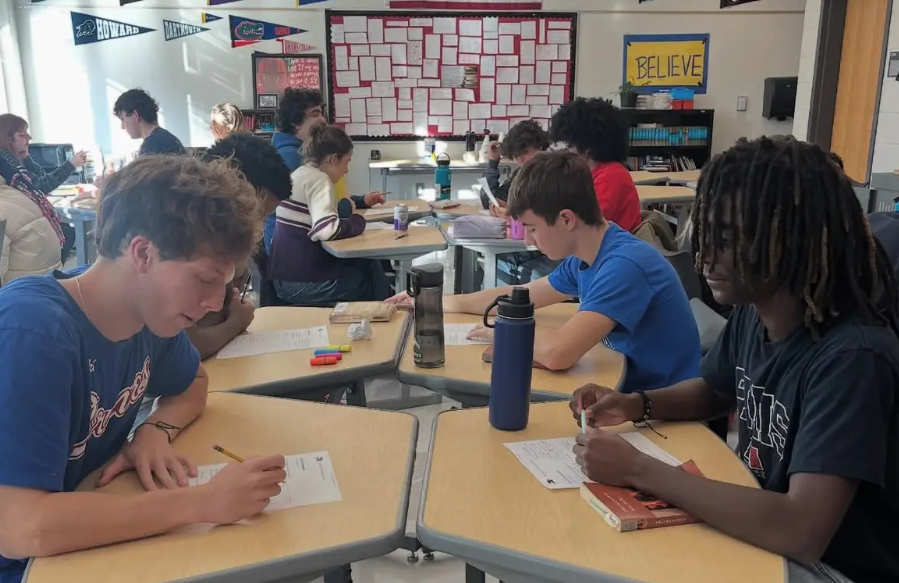
The AP Literature classes at Midtown are currently reading the original book. Senior Katie Albright credited the unique style of the novel for its timelessness.
“Mary Shelley is a very vivid and interesting writer to read,” Albright said. “The plot also, even though it’s been re-created many times, is very unique.”
The idea for “Frankenstein,” the novel, arose during a ghost story writing contest. 18-year-old Mary Shelley beat two of the world’s most famous poets, Lord Byron and Percy Shelley, her future husband, with her story of a scientist who reanimated man using body parts. However, theories that “Frankenstein” was actually written by Percy Shelley are almost as old as the book itself. The 1931 movie also credited her as Mrs. Percy B. Shelley.
AP Literature teacher Susan Barber said this historical treatment is reflected by feminist themes in the novel.
“That’s a lot of what thematically ‘Frankenstein’ deals with – women are overlooked,” Barber said. “[Mary Shelley] created science fiction, which is amazing … If people are overlooking and not crediting her with that, they’re just stupid.”
Many consider “Frankenstein” relatable to teenagers despite the novel’s age. Albright believes certain dynamics parallel the experience of seniors going to college.
“I could see it in the sense that Frankenstein and his monster have a parental-child relationship in some ways,” Albright said. “Part of the conflict of the book is that Frankenstein’s monster runs away, and his actions can’t be controlled by Victor anymore, so I could see that.”
AP Literature teacher Lisa Boyd said she consistently has to unteach stereotypical ideas of the novel.
“I’m like, ‘Wait a minute. Don’t call him a monster. Call him a creature,’” Boyd said. “Or they call the creature Frankenstein. There’s such a pop culture history about the novel that a lot of what has to happen is … some undoing of what kids think they know.”
Albright has noticed some common misconceptions, as well.
“A lot of us read this in eighth grade and were familiar with it,” Albright said. “I do think in general some people have the idea that Frankenstein’s monster is kind of this villainous monster when, in the actual book, [Victor] Frankenstein mistreats him.”
Del Toro’s portrayal of this mistreatment is part of why the movie is widely considered more faithful than other adaptations. However, it takes significant liberties. Notably, it portrays Victor Frankenstein’s father as cruel when the novel paints both of his parents as exceedingly doting. Boyd believes this choice oversimplified Frankenstein’s backstory.
“Sometimes, you’re treated really well, and that can also lead to another kind of arrogance, another kind of cruelty,” Boyd said. “Shelley’s original version plays up that idea of this much more complex conceptualization of human nature that this film version doesn’t do.”
Barber noted this complexity may have been what necessitated the change.
“A watcher of the film is really able to make that connection with Victor more,” Barber said. “In the book, I think it’s a little harder.”
The film has earned praise for its practical effects, something del Toro is known for. Up to 80% of American production companies used or planned to use generative artificial intelligence in their production process in 2023, but del Toro told NPR he would “rather die” than use it in his. Barber believes this stance paid off in the film’s visuals.
“The cinematography in this movie was absolutely stunning and amazing,” Barber said. “I could tell his vision for this, woven throughout every scene, whether it be indoors, out, and [in] the way he captured the Gothic elements in the cinematography. I think AI would have made it less interesting.”
Del Toro told Netflix that he “wanted to make [‘Frankenstein’] [his] own, to sing it back in a different key with a different emotion.” Boyd believes this approach worked, but that a change to the title to reflect it would have curbed skepticism from those familiar with the novel.
“[Del Toro] did take it in his own direction, but by not making the title also go in a direction … [with it,] it was hard for us to get on board,” Boyd said. “In many ways, I just don’t think Victor is the main character of that film. I think the creature is.”